 |
Solanum sisymbriifolium |
 |
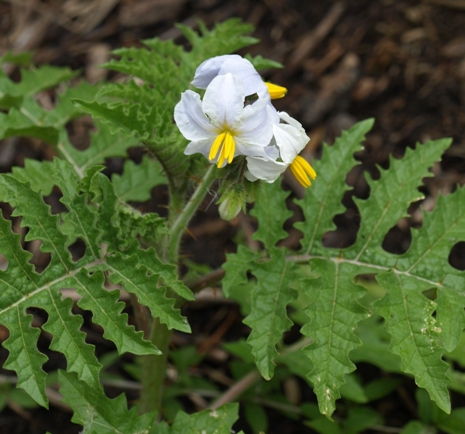
Generally classified as a weed - we'll judge for ourselves. I have a soft spot for spiny solanums, so growing this at least once was imperative. This one is fast-growing - blooming in mid-May, with crinkly white flowers.
|
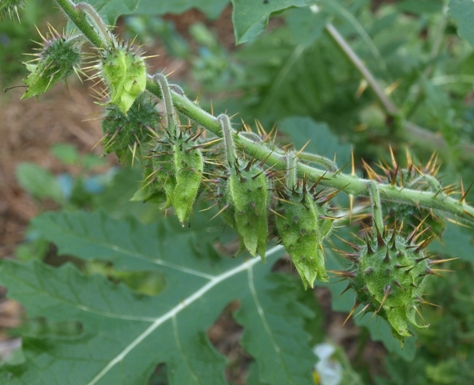
| | Developing spiny fruits |
|
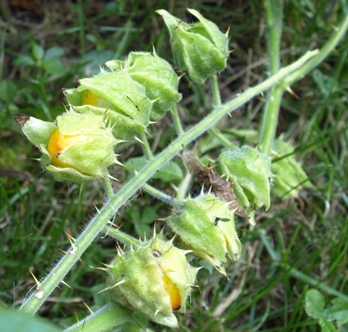
| | When the husks first open, the fruits are yellow... |
| 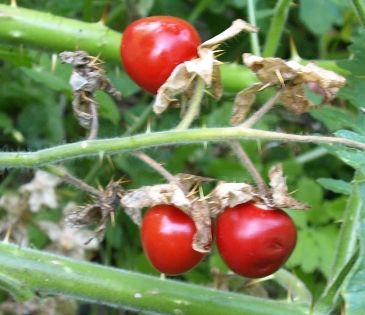
| | ...and then quickly turn red. |
|
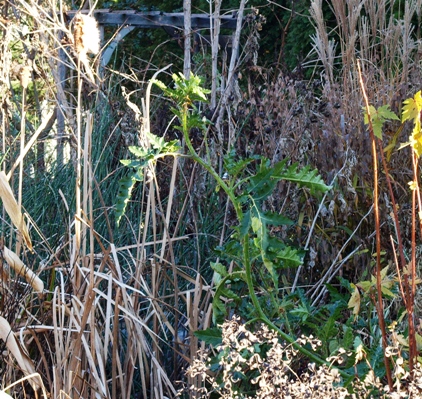
| | Surprisingly cold-tolerant – on this late-November day, the wild tomato was by far the greenest player in its garden area. |
|
This plant used to grow in our garden, but it slipped away... Read about the other spiny solanums in our garden One or more images of this plant are included in my stock photo catalog About my plant portraits
PlantLinks to other web pages about Solanum sisymbriifolium
Visitors to this page have left the following comments| ken at liseed.org | Aug 27, 2005 | Rob,
Your site is great. I really enjoy your blend of informative plant photos and your comments and pictures of nature in your backyard. All gardens should be like yours- full of diversity and neat critters to marvel at!
I just wanted to let you know that your labeled "sticky nightshade" is actually Nicandra physalodes (L.) Gaertn. AKA
apple of Peru also known as shoo-fly plant, all parts mildly toxic
Sticky Nightshade is Solanum sisymbriifolium which is a thorny plant, has eggplant-like flowers and husked red fruits.
I grow both of these out of curiosity I guess since USDA considers them invasive "weeds"!
You're right, of course. I have a separate page for nicandra, and moved the photos you saw out to there. Meanwhile, I've grown some real S. sisymbriifolium! |
| Bart Timmermans | Dec 28, 2005 | Hi i just finished my phd on this stuff: Solanum sisymbriifolium is used in The Netherlands as a trap crop for potato cyst nematodes (Globodera species). Actually, the nematodes are "fooled" by the plant, triggered by a number of chemicals to hatch out of their eggs and cysts (survival stuctures with which they survive for years in the soil without host), thinking it is a potato! And when hatched, the nematodes need a host-plant to reproduce. S. sisymbriifolium is not an adequate host, and the hatched nematodes die.
The plant does not like cold (below 10 degrees centigrade) and wet conditions (neither for gemination not for growth). Flowers either white or purple, plant size at least up to 1.5 m!, sharp thorns. Berries seem to be used for marmelade. |
| Jeroen Compagne | May 31, 2006 | 2006
This year I bought some seeds from an ecological farmer and seed trader that had the misleading name Thorny tomato. He told me the fruit was edible. The seeds where packed by himself and only carried the name thorny tomato no scyentigffic names where mentioned.
Since I figured the plant looks a lot like a nightshade I started too daubt his claim about this plants fruit being edible. I now have been searching the web for this dutch name Thorntomato (Doorntomaat) he claimed was this plants name and could not find any scyentiffic names. Some photos did however pop up. After browsing and searching I think that the plant is in fact a Solanum sisymbriifolium. This would mean that the fruits are indeed edible.
I hope so because I think i might try some...... |
| suresh Kumar Agarwalla | Oct 13, 2008 | The photographs are simply superb.Solanum sisymbriifolium grows wild here, can you pls. tell me about its uses.
I'm not personally aware of any uses - but hopefully other readers will comment with their knowledge! |
| A Powell | Oct 29, 2008 | Garden Organic (UK organic gardening organisation) had an article on Solanum sisymbriifolium recently. They reckoned it was a blight resistant alternative to tomato. Maybe not as sweet... |
| Robin Faulkner | May 22, 2009 | Good Afternoon Rob,
We have just been given a plant of Solanum sisymbriifolium and would be interested to know if does grow well in the bog border as suggested and wether it self seeds or if we would have to plant each year and maybe a dumb question are the fruits edible?
Apologies I have just read the next page and of course you have answered all my questions apart from the growing in the bog border.
I don't know how well this solanum tolerates soggy soil. I doubt it would be terribly bothered, but I may be wrong. |
| Oleg Zezelich | Nov 21, 2009 | It can grow on Croatian soil perfectly. And we have many types of ground and here where i live is colder than on the sea side but on summer it growes perfect. |
| Mariana | Dec 31, 2009 | linda Solanum sisymbriifolium , te cuento, a modo de curiosidad, que en el Chaco argentino los indígenas utilizan sus raíces para aliviar afecciones renales y hepáticas. :) |
| LaRetta | Aug 24, 2011 | S. sisymbriifolium destroys potato cyst nematodes (plague of the US potato industry and gardeners everywhere). We keep buying newer, improved strains of potato which are resistant but the nematodes adjust. It is constant battle.
Plant after your potato crop (it is an annual). Nematodes live in the soil to produce next year's crop of nematodes. But they think the nightshade is a potato so they hatch in fall and exit the cysts. Once outside, they find out that the nightshade is not a suitable host and they die. Then just turn the nightshade in the soil for extra fertilizer.
How interesting – thanks for sharing. |
| Paris Hairston | Jul 29, 2012 | this looks like a plant in my yard except the flowers here are yellow. Haven't gotten fruits yet but flowers have just started blooming. & my leaves look quite similar but aren't quite as dark and leaves are a little more variegated. Any clues? The spines & needles are identical though.... beadedwing@yahoo.com |
| Wolf | Jan 23, 2013 | It sounds to me like Buffalo Bur; Solanum rostratum for you Paris Hairston. I just wanted to attest to the edibility of this plant, its quite good and easy to grow, albiet a bit seedy! Dont forget, you need two plants for cross-pollination as the plant is self-incompatible! |
| plantporn | Jul 26, 2013 | Hi Everyone, I spend a lot of time collecting information on self-incompatibility of plants. Can anyone with direct experience independently confirm that Solanum sisymbriifolium is self-incompatible (that is, that self-fertilization results in no or extremely low fruit set) and cross-fertilization with the same plants works great? I would very much appreciate it. |
| Garnet | Mar 06, 2014 | S. sisymbriifolium is great fruit producing plant not only edible but delicious. I start and grow my own plants the same way I start tomatoes. I have had these plants for five years now, in Ontario, Canada. When the fruit is fully ripe the thorny calyx is fully curled back and the dark red fruit is removed with thumb and finger with a slight twist. I eat about two dozen fruit per day all summer. I usually have plants beginning to flower by the time they can be planted out. A good berry has a slight hint of a black cherry taste. If you don't bight down hard on them you will hardly notice the seeds. I love 'em! |
| S Thompson | Jun 18, 2022 | A recipe for litchi tomato mini-pies>. |
- Seed from '02 trade. Baggy 70F with light (90+%G, 6d)
- Same seed as above. Baggy 70F (67%G, 4-9d)
- Seed from '07 trade. Baggy 70F (10d) - 75F (30%G, 1-3d)
I welcome comments about my web pages; feel free to use the form below to
leave feedback about this particular page. For the benefit of other visitors
to these pages, I will list any relevant comments you leave, and if
appropriate, I will update my page to correct mis-information. Faced with an
ever-increasing onslaught of spam, I'm forced to discard any comments including
html markups. Please submit your comment as plain text. If you have a
comment about the website as a whole, please leave it in my
guestbook. If you
have a question that needs a personal response, please
e-mail me.
common mis-spellings: sisymbrifolium
Last modified:
June 18, 2022
Contact me
|