 |
Spiny Solanums |
 |
The case of the spiny eggplants
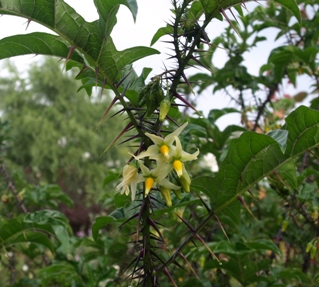 You've heard of prickly pears. But are you aware of their equally intriguing
and just as needly relatives, the spiny solanums? The relationship is not
botanical, mind you - those pears belong in cactaceae, whereas the topic of
this page concerns a few species in solanaceae. But they do share some other
characteristics besides the need to wear gloves to handle them: attractive,
and sometimes edible, fruit, and a bit of an oddity in the garden. Sound
interesting? Read on — I'll describe the six species I've grown on the
page below.
You've heard of prickly pears. But are you aware of their equally intriguing
and just as needly relatives, the spiny solanums? The relationship is not
botanical, mind you - those pears belong in cactaceae, whereas the topic of
this page concerns a few species in solanaceae. But they do share some other
characteristics besides the need to wear gloves to handle them: attractive,
and sometimes edible, fruit, and a bit of an oddity in the garden. Sound
interesting? Read on — I'll describe the six species I've grown on the
page below.
My first experience with this botanical genre came early in my gardening
career. I had just taken up seed-starting, and had yet to discover the
wonderful world of online seed trading. Instead, I collected seed catalogs,
and placed orders with quite a number of suppliers. An early favorite was the
catalog of J.L. Hudson, Seedsman -
both for the reasonable prices and the wild variety of interestingly described
plants. Among the many curiosities I ordered were balsam pears,
hairy-leaved chiles, and bundleflowers, some of which still inhabit our garden.
But the one I remember best was Solanum atropurpureum, whose description
included a quote from a botanist proclaiming the majesty of this ferocious
plant, ending in I call it 'Malevolence'. I can no longer find the full
quote (let me know if you have an old catalog containing the blurb!), but
'Malevolence' has always stuck with me; I continue to call these
plants by that name.
S. atropurpureum sure was an oddity. Already as a seedling, it had
purple stems, and was covered in sharp thorns - not just along the stems, but along
the leaves too. That year I shared many extra seedlings with a fellow
gardener. I made sure he left with a couple of Malevolence seedlings, which
seemed to intrigue him as much as me. But when I asked after the plants a
few weeks later, he confessed they had not passed his wife's approval, and
had not been admitted into their family garden. My dear wife knows better
than to interfere directly with my botanical experiments, so our plants grew
and prospered. And so began my interest in this little corner of the Solanum
genus.
Since then I've sought out several others; each is quite distinct, and
described with photos below. All of them are in the subgenus
Leptostemonum of genus Solanum (which also houses the common
eggplant), but their paths diverge from there: they belong to different
sections of the subgenus. If you know of any additional ones I should try,
please let me know.
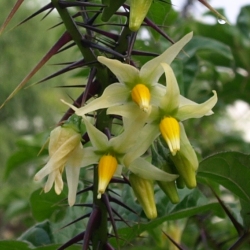
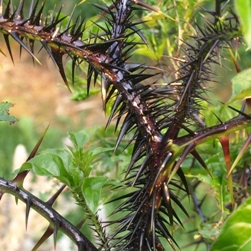
Habit. This is the tallest of the four, growing sturdily to at least
five foot tall when it's happy. It's big around too, so that a few plants make quite the
impenetrable thicket. The species gets its name from the deep purple, almost
black, coloration of the stems and thorns.
Thorns stand in amazingly dense formation along the
main stalks. They also run along the leaf stalks (petioles), the
flower/fruit stalks (peduncles), and along both the tops and the bottoms of
the main ribs of the leaves. They stop short of the fruit itself, which can
be picked without too much danger of puncturing fingers.
Leaves are mid-green, smooth-shiny, and deeply lobed.
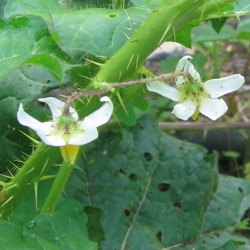
Flowers start appearing in the heat of summer,
in mostly downward-facing clusters. The recurved petals are creamy white,
while the bundle of stamens is a stronger yellow. Not particularly showy,
but nice enough up close.
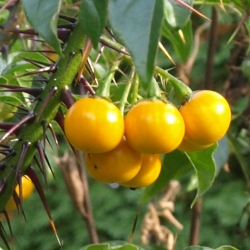
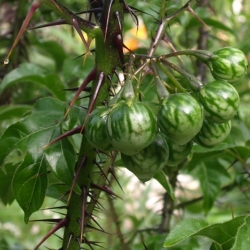
The fruit competes with the dark-shiny thorns for the
distinction of 'most noteworthy aspect'. The plants set an abundance of it,
about the size of common marbles. They start off striped in two tones of green,
then color a rich yellow by early fall.
The classification of this one is confused; I received this as (seed of)
S. surrattense, but according to GRIN the
correct taxon is S. virginianum, another synonym being S.
xanthocarpum. All three names are found in online references to similar
plants, sometimes with photos and descriptions that don't quite match the
plants we've grown under this name. If you know the details, please feel
free to set me straight! Common names include Surrattense nightshade and
Kanta Kari; I assume the latter is the name used in India, its native
country. I've found it used mostly in an herbal context. Although I can't
vouch for the medicinal benefits of the fruit though, it supposedly has mild
purgative as well as antibacterial properties. In Indian medicine it is even
used to combat balding of the scalp. Your mileage may vary.
Habit. Although in proper climates this grows to
be a shrub, when grown as annuals they are quite a bit shorter in stature
than atropurpureum, ours haven't grown taller than two to three feet.
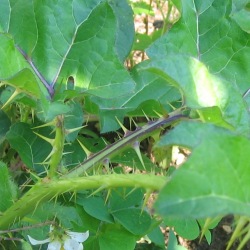
Its light green thorns aren't as eye-catching as some
of the others, but just as
sharp. Most parts of the plant, including leaves and fruit bracts, are prickled.
Leaves are mid-green, softly hairy (that is, where they
are not prickly), with irregular (but not particularly lobed) margins.
Flowers arrive in early summer. They are white and
face downward - not much of a show.
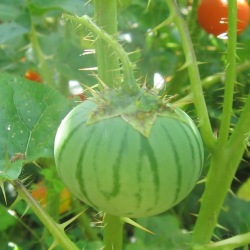
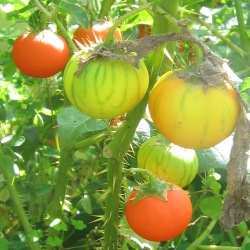
It's the fruit that really defines this plant. They
are squat, the largest about the size of a chestnut. These too start out
stripey-green, and progress to yellow. But they don't stop there: after yellow
comes orange. The fruits ripen at different times, so that by late summer all
colors are represented. It's even more interesting-looking after a freeze has
killed off the foliage, the fruit still dangling colorfully from the
darkened branches.
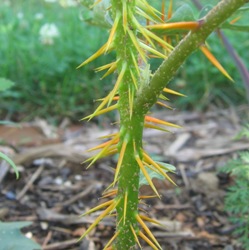
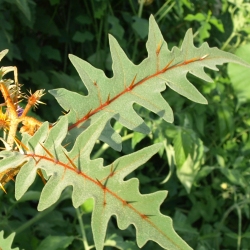
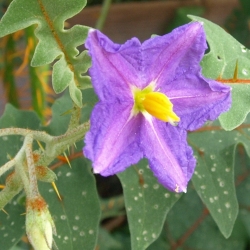
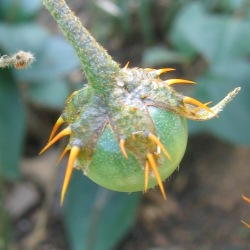
The species name of this plant, hailing from Madagascar, is Greek for
fire-thorn; I've also seen it called porcupine tomato. Both names are
appropriate for this startling plant!
Habit. Not quite as tall and a bit more freeform
than atropurpureum, this is still a substantial plant. It does well
when provided consistent moisture, in which case it can grow to four foot
tall in one season.
There's no doubt the the thorns steal the show on
this one. They are long and feasome, colored orange to yellow, and clearly
meant to protect all parts of the plant: all stems are covered in varying
density; the leaves have spines not just along the midrib but also along several
other nerves; and for those who would dare pick the fruit, the plant sends
fierce prickles downward along the fruit bracts.
The soft hairs on the leaves and stems gives them a
dull or silvery green appearance, depending on how the light hits them. The
leaves are long, and lobed in a gentle zig-zag.
Attractive purple flowers with prominent yellow anthers keep
coming all summer. They look like those of the common eggplant,
with papery-crinkly fused petals; look at the backside of the corolla to see
a silvery star.
Fruit starts out inconspicuous, and stays fairly
small - the size of a large blueberry. It doesn't ripen until early fall, when
it eventually turns yellowish orange.
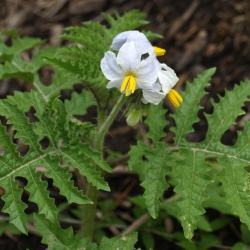
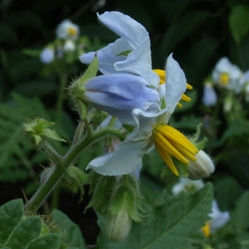

This species, native to South America, is generally classified as a
weed. I would have to agree that it's the least gardenworthy of the ones on
this page, but I'm still glad I've grown it. Its common names include
sticky nightshade and litchi tomato.
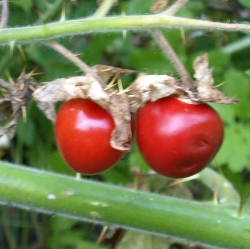
Habit. Like real tomatoes, this plant can't decide
whether it wants to grow up or sprawl. When young, the plants are well enough
contained, but as the season progresses the stalks grow more wildly, posing
a scratch hazard to passers-by.
Its thorns aren't ornamental. They are green and
not terribly long (though still plenty sharp), occuring mostly along the stems,
with some wayward prickles along the leaves. The only thorns that are
visually prominent are the ones protecting the fruit.
The leaves are architectural, and quite
handsome in strongly growing plants. They are deeply divided along their
considerable length, with wavy serrations along each of the divisions. Leaf
surfaces are hairy and prominently veined, contributing to an attractive
three-dimensional look.
The flowers are actually quite nice: varying in
color from powder blue to white, with bold yellow anthers, they are held above
the leaves and are large enough to make a statement.
It is fascinating to watch the fruit develop. Soon
after the flowers fade, viciously thorny husks develop from the bracts to
protect the developing fruit. They remind me of medieval weapons. After some
time the casings start peeling away, to expose yellow berries. Finally, as
the bracts shrivel up, the berries turn shiny bright red - looking indeed much
like a small tomato. They reportedly have culinary uses similar to tomatoes,
but I'm not sure I'd want to harvest them in large quantities. Even just
harvesting enough for seed, my fingers didn't appreciate the encounters
with the shriveled husks; the thorns seem to only get sharper as they dry.
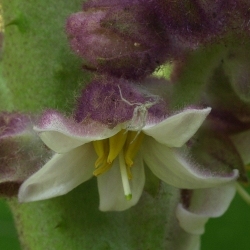
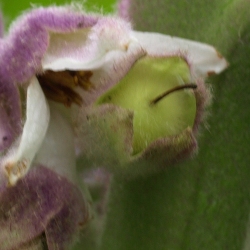
Another South American species, this one will grow into a tree given the
right conditions. The plant and its fruit are known as naranjilla.
Habit. The most striking feature about this plant
are its large leaves, which announce 'I'm Tropical' with a sense for drama.
Through the years, I've made three attempts to grow it. The first two times I
was pleased with its verdant velvety leaves, which stayed close to the ground
– I thought that was all I was about to get from this perennial species
in a single year's growth, but my recent attempt proved me wrong. For reasons
unknown to me, my two plants took off vertically, making many more leaves on
sturdy stalks. By late summer, they overwhelmed the rose in front of which I
had placed the naranjillas. I guess this was their Dr. Jekyll year.
Even more interesting is its attitude towards thorns.
I don't recall seeing any during either of my first attempts; the more
recent lofty duo mixes it up: one is entirely without thorns, the other has
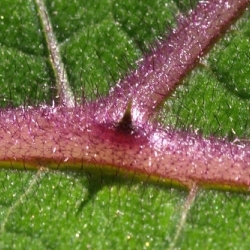
them in all the regular places: on the top and bottom surfaces of leaves (most
prominently along the main veins), and along the stem. In all, the prickles
are not important ornamentally, but I'm intrigued about the genetic reasons
behind my observations (all plants were grown from the same seed lot).
visually prominent are the ones protecting the fruit.
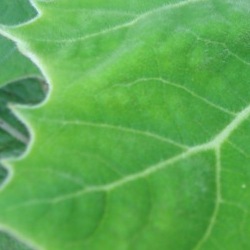
Did I mention that the leaves are large and
velvety? Do not pet the naranjilla - it may have hidden prickles. On
young plants, the veins that traverse them are a lighter shade of green;
older plants feature pink veins. The leaf margins are attractively
scalloped.
Flowers arrived late in the year, and only in my most
recent cultivation effort. Fuzzy purple buds appeared close to central stem,
mostly obscured by the leaves above. A few weeks later, they opened to
thick-petaled white flowers, which contrast with the purple bracts. Not highly
ornamental, but worth bending over for a closer look.
A few weeks after the flowers appear, the fruit develops.
I hope to have more information soon – right now, I just have small
greenish starts. Ours may never ripen, but if they do, they reportedly make
a nice fruit juice.
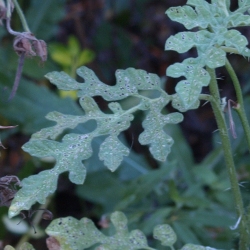
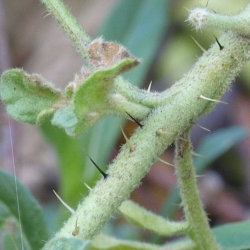
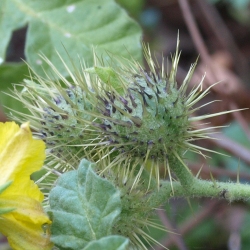
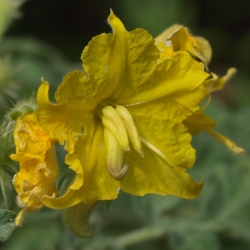
This one hails from less far-flung regions: it is native to the U.S. plains
states, where it can be a troublesome weed of pasture land. Its common name
is buffalo bur. A friendly gardener from Texas found this page, and sent me some
seed so I could try an additional spiny solanum. Even given its reputation as
a pest, I had to attempt it at least once – but one season of growing it
in less than optimal conditions won't allow me to do it as much justice as the
other species described here.
Habit. Not so tropical. Given the location I
provided (dry, not too fertile – why pamper a weed?) my plant probably
didn't reach its full potential. It will grow one to two feet tall, but mine
stayed at the lower end of that range, with a scraggly habit. During much of
late spring and early summer it was barely visible, and feasted on by flea
beetles. It did come into its own in late summer, but by then the drought
conditions had driven me from the garden, so I didn't pay as much
attention.
The thorns on this one are of the functional rather
than ornamental variety. The stems are lined with little sharp prickles, some
light, some dark in color. I didn't notice thorns on the leaves.
If the overall habit were more attractive, the leaves of this species could be quite an asset. I liked
the irregular, squiggly margins on the bluish green composite leaves.
Flowers appeared in September. The bright yellow
fused petals have a crinkly texture and are more substantial than those of
most other species described here. The prominent stamens are also yellow.
Overall, quite attractive.
Several weeks later, I noticed the fruiting bodies.
Predictably, they were covered in impressive thorns. I was pleased that they
got to this stage, but neglected to observe their further development. So I don't
have photos of the actual fruit to share.
Garden use and cultivation
I've not experimented sufficiently with these plants to know how they
respond to different garden conditions. It's safe to say they all appreciate
a healthy dose of sunshine, and reasonably fertile soil. Some are thirstier
than others - S. sisymbriifolium and S. atropurpureum have
thrived in fairly dry conditions, where the others would have struggled.
So how to use these striking plants in the garden? My dear wife might
advise "Just don't do it", but of course that's not an option for the
curious gardener. My advice is to keep in mind that these plants grow to a
substantial size, and place them accordingly - far enough back in the border
that the arching stems won't reach to grab hold of skin and clothing of
passers-by, but not so far back as to hide their distinguishing features.
This takes some experimentation - last season, the S. pyracanthos I
planted close to a newly planted rose wound up overpowering its equally thorny
neighbor, as well as the plantings in Lily's girl-garden to the other side.
I guess the fertile soil I provided for the rose worked wonders on the
solanum as well!
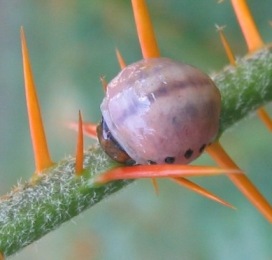
Flea beetles and false potato beetles both feast on S. pyracanthos
and S. rostratum, just as they do on edible eggplants. For much of
the year, the leaves are dotted with small holes, which does detract from
the plant's appearance. For some reason, the pests are less attracted to the
other species.
The first four species above are more cold-tolerant than the common edible
eggplant (S. melongena); they still stand proud after a few autumn frosts into the high 20s,
before they finally give up when the temperatures dip even lower. I tried once
to overwinter S. quitoense indoors, but it didn't work out – that's par
for the course for me, I'm no good at getting tender plants through winter.
Propagation
The fruit of each of these solanums are chock full of seeds, so that just
a few berries suffice to get a good seed harvest. They ripen late, well into
autumn in our climate. Luckily, I've found that the seeds are still viable
even after the berries have been subjected to hard freezes - so I usually wait
till November to harvest.
Germination is easy. All species sprout fairly quickly at temperatures
slightly above room temperature. They proceed to grow strongly, so don't start
them too early; I usually wait till late March, so that I can start hardening
the seedlings off in late April, and set the plants into the garden in May.
Visitors to this page have left the following comments| Heidi | May 27, 2011 | Spiny eggplants -- why?
Because they're there? |
| julie floyd | Nov 30, 2011 | i loved this page! Informative and Passionate! Although, i'm not sure it covered exactly what i was in search of. I walk past this plant that reminds me of an eggplant bush but it has very spiked fruits a bit smaller than a tennis ball. The leaves are more closely resemble the eggplant cultivars at the local home and garden stores (large,and green with purple undertones) than nightshade weeds that grow around here in ga(small, spiny. The flowers a large and white and "close up" similar to an angel trumpet. It seems to have been planted rather than be wild. It also seems a bit invasive. Very interesting. Any feedback greatly appreciated.
Could your mystery plant be a datura? There are other varieties with different flower colors, the linked one is just the one I've grown. |
| Travis | Jun 19, 2012 | Hey Rob. You mailed me some seeds and I just wanted to let you know that they're doing great! One of my S. sisymbriifoliums is five feet tall with fruit set in a 30" pot, and its friend that I kept for cross-pollination is also pretty big. I just started a little baby S. rostratum and it's cute. I was too lazy to cold stratify the S. atropurpureum but I also have an S. carolinense and S. melongena that are blooming, and so I'm sort of having comparative morphology in my rock garden this summer. Oh yeah, and I have Naranjilla seeds on the way. Thanks for inspiring me!
Excellent! By the way, no need for cold stratification on the S. atropurpureum. Just give it nice and warm conditions, like the others. |
| Lesley | Feb 10, 2013 | Will any of these plants grow as perennials in San Antonio, TX? Zone 8b/9a. I'm looking for something thorny to fill a bed next to a fence to keep the dog out of the bed and away from the fence. |
| celeste | Jun 20, 2013 | Just bought a spiny eggplant labeled only as Solanum Eggplant. Bought it, like you, out of curiousity. Not for everyone but I like the unusual. Curious to see what it will do in the Minnesota summer. |
| umbrellalady | Aug 13, 2013 | I am trying to find out the type of eggplant I recently acquired from a local greenhouse that was just starting out. The grower, unfortunately, did not keep the seed packet and has no idea what type of eggplant it is. So far it is about 2 feet high (we have had a cool season so I suspect it would be much taller) and has very sharp spikes on both the top and bottom spine of the leaves. These are quite long - about an inch. The fruits are just starting and are like a squat pumpkin - colour is green at this point and still small. The leaves are somewhat pointed almost like a poinsetta leaf.
Sounds like a fun plant! If it's not among the ones featured on this page, I have no clue what it is. I'm learning there are quite a varied number of spiny solanum species :-) |
| steve | Aug 31, 2013 | looking to find the name of a "weed" trileaf spiney fruit small white flower |
| dr. S. N. Lungare | Aug 09, 2014 | it is not Solanum virginianum: Christmas tree
it is Solanum aculeatissimum
Thanks for your comment. Looking at online photos, I still can't be sure, but now I know that there's at least one additional possibility for this plant's identity. |
| yoohowni | Aug 22, 2014 | very informative.some of these could be use for grafting tomatoes to overcome bacterial wilt. |
| Toby C. | Oct 03, 2014 | We've planted both the Malevolence and the S. pyracanthos along our front walk with the intent to deter solicitors. I'm really looking forward to expanding the collection! I want to have a wide variety in case any are damaged when I accidentally shoulder-check a canvassing politician or salesperson into the patch of thorns. Alas, our climate doesn't permit them to overwinter so I'm hopeful I can save seeds. The malevolence variety also seems to be prone to a tall and skinny habit - maybe it would be more inclined to branching or spreading if it's pinched off? |
| Leonore | Nov 03, 2014 | Just read about the Tropical Soda Apple Weed in the solanaceae family, also night shade like your varieties. All of you enjoy your plant but I sense no vigilance on your part, that birds may spread seeds, and these thorny plants may migrate to places where they do damage. Pl be cautious. I discovered here in MA today a variant of the Solanum family, and I would NOT like to see it spread, weed lover that I am. Pl read up on containing plants, and repercussions if they spreading on their own.
Most of the species on this page are tropical, and stand no chance of proliferating in our climate. I'm certainly aware of weedy solanaceae – our garden has several, not by my choice. |
| Kris | May 23, 2015 | Somehow this strange, spiny plant showed up in my vegetable garden. From your photos it looks to be S. rostratum. Will the fruits be edible or are they medicinal? Thanks for info.
I've not tried to ascertain whether the fruits are edible. For me, all the plants described here are purely ornamental (or "visually interesting", anyway). |
| howard | Jun 19, 2015 | please add the approx. height and speed of growth to your discription
Detail information about the individual species is listed on the pages dedicated to those species; they are linked from the headers on this page. |
| Syracuse, NY | Jul 15, 2016 | We are first-time gardeners and two of the plants we experimented with are Ronde De Valence and Listada de Gandia eggplants.
From the seedlings we got, we planted about 6 in the garden, but currently we can't tell them apart (until we get fruit). The weird thing is that one of the plants seems to have developed spikes, similar to what your S. virginianum pictures here show. We didn't expect that and actually are still wondering if it is one of the originally planted items or some weed that otherwise looks just like the other eggplants. I guess we'll have to wait and see. |
| jamie h | Feb 17, 2017 | I love this blog, thanks! I added the purple one to my Creepy Gothic Garden collection :) |
| Elizabeth (Lizzie), Halfway to Poughkeep | May 31, 2017 | Wow, holy Moses. Someone shared this page after stumbling (fortunately not literally) upon what turned out to be S. pyracanthos at a wholesale place. I have developed an interest in nightshades and have selected a place on our property to locate some native and "guest" wicked plants (nightshades plus a few others) , and I definitely need some of these! I hope most of them are tender/unable to escape and wreak havoc in our zone though. |
| Regina | Jun 11, 2017 | Thank you for sharing!! I misidentified these in the field during a survey, as a spiny eggplant, and was corrected that it's a variety of nightshade, specifically S. virginianum. Thank you for all the detailed information and awesome photographs.
tomayto tomahto :-) |
| linda in vermont | Jul 23, 2017 | How did this plant get in our veggie garden..the ground that was tilled never had a garden there...many many years my boyfriend had horses and all the manure was spread there..just weeds and grass grew...this spring it was tilled and rabbit droppings were added...seeds were planted and started to grow...along with the thorny horrors..,EVERYPLACE in the garden...they are interesting and...unusual..how in the world did they get there...and only in the veggie garden?
That's interesting. Some of the spiny species are native to the US, but none to Vermont as far as I know. Must have come in with a soil amendment – maybe those rabbits had some interesting snacks? |
| Cheryl | Sep 25, 2017 | Saw a spiny something at the National Vegetable Garden in WDC. Thought it might be in the nightshade family. Found your site out of curiosity about those plants. They didn't look exactly like anything you've pictured but close enough for me to satisfy that they were eggplant. In July they were about 2' tall and over 3' across. The leaves were radial on a single sturdy stem, about 6" wide, dull, velvety, and softly scalloped. Central rib was a deep purple-red with thick, shiny, evenly-spaced spines, also deep purple-red, up to 6" long on the underside of the leaves, under 2" long on the top. There were no blossoms or fruits on the plants at that time. |
| Kevin | Aug 09, 2019 | Thanks for identifying solanum rostratum. It came up, presumably with the steer manure, and I didn’t know what it was. Actually I’ve seen it growing in various places and always thought it was some kind of squash |
| Dina Brown | Jul 12, 2020 | I am growing a variety of eggplants this summer, but have not marked them as I want to be surprised. One that I planted is solarium stromonifolum, which we enjoy because our family is Thai, This is the small orange hairy eggplant. One of my eggplants has thorns in the center rib. Could this be the hairy one? I haven't been able find a picture of the leaves for this. All the others are thornless and thriving in our humid and pleasant Hawaii climate. Thank you for your input. |
| Megan | Apr 05, 2022 | Thanks for the great info Rob. I have the porcupine tomatoes plants. Deers still eat the leaves. Grrrr. |
| Jean Whiteman | Jul 08, 2022 | My neighbor always grew egg plant in containers in the front of his house. Now that he moved I am finds in his backyard plants with an eggplant like leaf with big spikes on the stem. Will this plant produce an edible eggplant? I live in Pittsburgh Pa. Thanks
It's not likely to be an eggplant of much culinary interest. I certainly wouldn't try to eat it without getting a positive ID on the plant. There are many thorny solanums out there. |
| Sebastian | Aug 17, 2023 | I've been growing S. sysimbriifolium sunce last year, and one cool aspect of them is you can overwinter the roots - just cut them back all the way, put them somewhere frost-free, and they should sprout anew the next year. It's mildly frost-tolerant as is, too. The best thing about my second-year plants was that they were much more hardy and grew faster than the next generation I grew and kept in a greenhouse this year. Once the fruit is very ripe, they just about fall off on their own, and are easy to pick without an acupuncture treatment for your fingertips, too. Helps that the calyx peels back at this time, as well. It's almost impossible to tear them away before that. I think with all those seeds the taste and mouthfeel is kinda similar to kiwis. |
I welcome comments about my web pages; feel free to use the form below to
leave feedback about this particular page. For the benefit of other visitors
to these pages, I will list any relevant comments you leave, and if
appropriate, I will update my page to correct mis-information.
Note that I discard any comments including
html markups, so please submit your comment as plain text. If you have a
comment about the website as a whole, please leave it in my
guestbook. If you
have a question that needs a personal response, please
e-mail me.
Last modified:
November 30, 2011
Contact me
|