 |
Coix lacryma-jobi |
 |
| Common name |
Job's tears |
| Family |
poaceae |
| Life cycle |
tender perennial |
| Flowers |
green |
| Size |
3-4' |
| Light |
sun-part shade |
| Cultural notes |
ordinary garden soil, not too dry |
From seed  |
Soak, germinate at room temperature or slightly warmer. Scarification may be helpful.
Flowers first year from seed sown indoors early.
detailed seed-starting info below
|
| Seed ripens | late September |
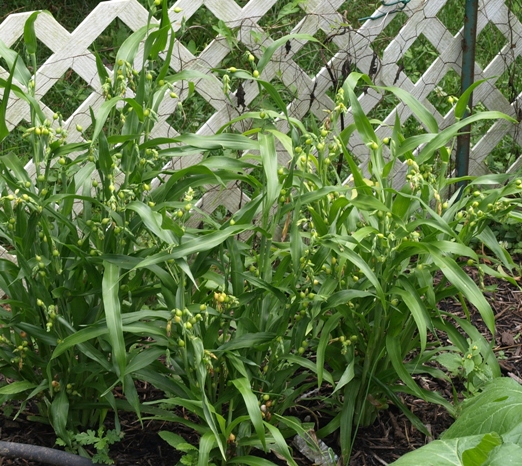
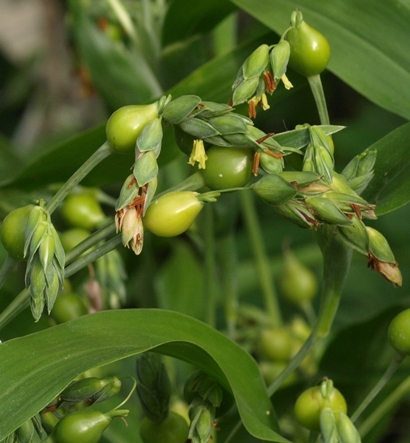
The pearly gray seeds of this grass species are used in necklaces. The foliage is like floppy corn, mid-green in color. Flowers arrive early on, although they are easy to miss, being mostly green – the yellow tassels can only be seen when you get up close. Seeds start developing shortly thereafter (by early summer most years, for plants started indoors in March), and continue on through fall. They progress from a lustrous green to black, and finally a shiny gray color. Seeds can be harvested when they are uniformly black – they will acquire their pearly sheen in storage. Seeds that turn white or a duller gray are likely not viable; I used to recommend a float test, but see comment below for experimental evidence that that's not a reliable method of separating viable seeds from duds. Still, obviously light-weight seeds are sure to be non-viable. I've never managed to grow Job's tears as impressive as others do, but most years I got a good crop of seeds. At least, that was the case when I was gardening in Pennsylvania. As shown in one of the photos below, my results in the Houston climate have been decidedly more meager: the plants look bedraggled, and the majority of the seeds are in the dud category. I'll keep trying for a bit: I would have expected good results in our hot and humid climate, so maybe I'm doing something else wrong...
|
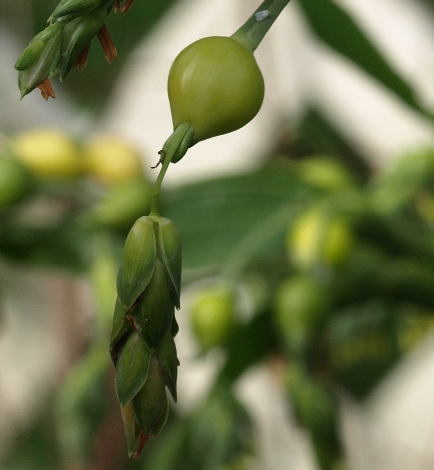
| | Close-up of the procreation apparatus |
| 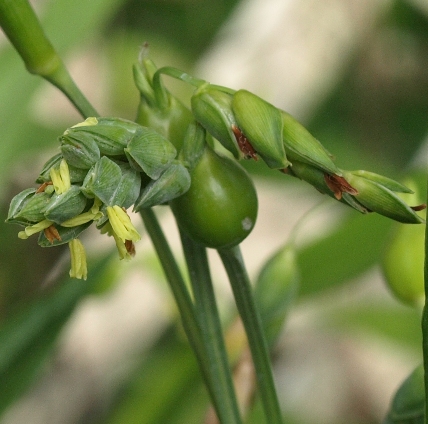
| | Red bits and yellow bits (I'm quite the botanist, don't you think?) |
|
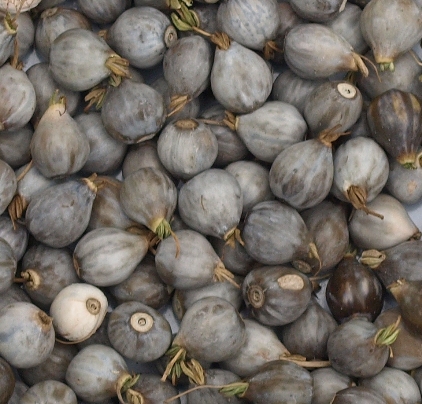
| | The pearly beads look great en masse |
| 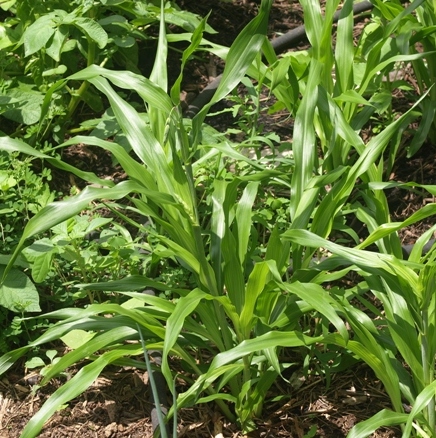
| | Just starting to burst into growth with the arrival of late-spring warm weather |
|
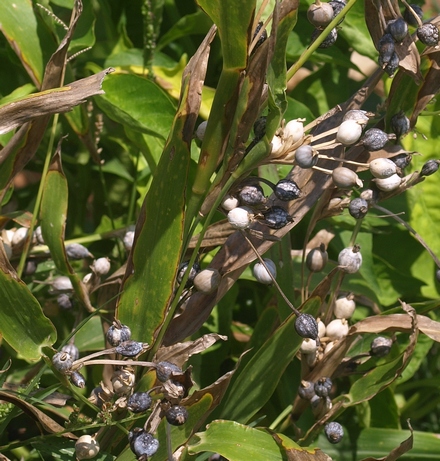
| | Lots of duds on our Houston crop |
|
This plant used to grow in our garden, but it slipped away... Seed for this plant is included on my seed trade list About my plant portraits
PlantLinks to other web pages about Coix lacryma-jobi
Visitors to this page have left the following comments| Anna Maria Ballarin | Apr 05, 2005 | Thought this plant is also known as Jacob's Tears in some parts of the world. |
| jim burns | Jun 17, 2008 | first met jobs tears as necklaces in PNG highlands. Read there are cultivars in Sth America. Now find grown as a food plant in Laos. My Qs: where the hell did the plant originate? When did it spread to other parts of the world? How did it get there? If anyone has evidence & source of it I'd be obliged if you'd email me: nagalao@yahoo.co.uk |
| Rev. Mary | Aug 15, 2008 | I especially appreciate the helpful info you have given on Job's Tears. I have long searched for the name of the plant that produced "natural beads" that Native Americans made necklaces with. Fifteen years ago I bought a necklace made of Job's Tears and have wondered about these little creations ever since. Now I feel so very blessed with all the information I have at last been able to gather about them. You list them as a perennial, and I find them listed elsewhere as an annual. Well, with your seed starting tips to help, I hope to find out come next year about this. I am excited to be able to at last try this venture and hope there will be a place in my garden where they will feel "at
home" and thrive. I would like to try making some jewelry of my own, and even perhaps try to cook some as a cereal as I have also read can be done. THANK YOU for the fine photos that show me what to be looking for in my garden !!
I list it as a tender perennial - which means it is perennial in tropical climates, but cannot be grown as a perennial where I garden. So we treat it as an annual. |
| Al | Aug 16, 2009 | Hi, I grow Coix lacryma-jobi. I use the grey seeds and soak them in hydrogen peroxide in a half day sun window seal until they start to germinate, usually 2 days, I have a 95% germination rate. I take out the seeds as they start to germinate and put into potting soil. My plants are loaded. I did learn that if you mix fertilizer in the soil when you plant them they do not do well, it stunts and burns them. Water with miracle grow and put a little fertilizer on top of the soil for best results. afowlerusn@verizon.net |
| alfiana Anna | Sep 03, 2009 | I'm so interested with this plant. i come from indonesia. we call this plant JAGUNG JALI, especially in Javanese. i also interested to make my last paper about JAGUNG JALI in my university. so, do you have more information about JAGUNG JALI research? where or how i can get it's information? thanks and please email me (her_alf@yahoo.co.id) |
| mike | Feb 09, 2011 | i have made four neckles from the tears they are supose to be good luck |
| Sarah in Az | Apr 05, 2011 | Hey there this site is great! I was wondering though, in the seed starting section, what does "baggy" mean? Seems to be better germination rate for that. I have had like 50% no matter what I tried with job's tears. Last yr we tried to grow some of the food grade (softer shell) kind, had a friend in Japan send them, planted them right out in the garden and watered every day and germination was more like 75%, but they barely made a handful of seeds! Actually some that never came up last yr are starting to come up now. The package is all in Japanese though, so if it does have starting instructions I'll never know LOL. Hoping to grow and get enough seeds to have a real crop next yr. One plant of job's tears usually gives us about a quart of seeds, hoping these food grade (adlay) will do so good.
See my baggy page for a full description of seed-starting in baggies. For Job's tears, it helps to nick the seeds using a file and give them warm conditions to germinate. Lightweight seeds will not germinate - they are empty. |
| Rogelio Arce | Nov 18, 2011 | I have about half acre of this plant, in the cattle farm, I dont know how it came to that place. They are good luck pearls.
Wow, that must be quite a sight - especially right after those pearls drop. |
| Kelly Hancock | Mar 27, 2012 | Greeting from Austin,Tx. I love your site, found some very old Job's Tears seeds that came from my Grandmother's yard in Lafayette, La. with all of the helpful info on your site I am going to give it a shot and see if I can get them to germinate. http://www.louisianafolklife.org/LT/Articles_Essays/Job'sTearsRosaries.html
Good luck! I've often wondered how long they stay viable, so I'm curious to learn how you fare. |
| Donna Bauman | Oct 25, 2014 | What causes a fungus or infection in Job's Tears. Can it be cured? How? Would the infection or fungus spread to other plants? Would this mean re-planting with new seeds Would the fungus or infection prevent the growing of Job's Tears entirely or would planting in a different location be all that is necessary.
Thanks you for any extra time or effort on my behalf,
I'm afraid I have no knowledge of fungal diseases in this plant – nor am I aware that such things are a problem with Job's tears. |
| Rose. | Mar 15, 2016 | HI Rob, I got my job's tear seeds rather quickly Thank you they have already sprouted I'm looking forward to harvesting some nice beads thanks RW |
| Ken | Jun 16, 2017 | Just want to share my experience with the float test on Job's tears viability. In the past I've soaked my seeds overnight and just planted everything with good result. This year I decided to do a comparison between the floating and sinking seeds. I soaked 20 seeds (harvested 2014) overnight. The next day, I found 9 seeds had sunk to the bottom of the container and 11 seeds remained floating. I germinated the sunken and floating seeds separately between damp paper towel in baggies. Overall, 17 of the 20 seeds sprouted: two of the sunken ones and one of the floating seeds did not germinate after three weeks. Neither group of seeds germinated very much faster than the other (first floating seed germinated one day after the first sunken seed had germinated). A seed was considered germinated when I saw the first root some out of the seed. Hope this information is useful.
Thanks for sharing. Experiments are good! |
| Josue | Sep 10, 2018 | I´m from Costa Rica, I have the edible variety wich is all brow-yellow and I need to know a method to peel off witout damage most og the seeds.I have used a hand mill, i don´t konow the word in english, is used to grind corn. As I said most of the seeds breaks, I use first a fan to separated cebris and then water. I used to mix with the rice. |
| Juan | Dec 14, 2018 | In Cuba we call this Santa Juana, very treasured by the kids back in the 60s for hippie-style necklaces. But I have never seen it grow anywhere but on the banks of creeks or canals. |
| Ken | Apr 11, 2019 | After another year of growing, I'm starting to think this plant is photoperiodic and flowers under shorter days. Last year I planted from the same batch of seed in two different latitudes in Canada (43.65N and 49.89N). Despite starting the seeds two different ways (baggie in the north vs direct seed in the south)and planting out at different days, the plants both started flowering around the same time in mid to late summer and set about the same amount of green seed. The only thing that led to no harvest in the north was earlier frost. It looks like your plants in Houston suffered some drought stress during flowering and seed set. That was how some of the ones I had on my balcony looked after they recovered from a drought spell. The south-east Asian grain varieties of job's tears are sometimes grown in shallow paddies, so these plants can thrive with a LOT of water.
Interesting observations. Maybe I should attempt to grow a plant as a pond marginal and see how it does... |
- Seed from '99/'00 AHS exchange. Soak overnight, cellpack 70F (90%G, 13-15d)
- Seed from '03/'04 AHS exchange. Soak overnight, pot 70F (20%G, 15d)
- Seed from '04 garden. First attempt: soak overnight, pot 70F (no G). Second attempt: sandpapered a window into each seedcoat, baggy with peat moss 75F (37%G, 8d)
- Seed from '05 garden. Nicked, placed in baggy with potting soil at 75F (10%G)
- Seed from '07 garden. Determined that only the pearly-gray seeds are viable - black and white ones are not. Nicked individual seeds with a file, baggy 75F (89%G, 7-13d)
- Seed from '08 garden. File-nicked, then baggy 75F (78%G, 8-16d)
- Seed from '09 garden. File-nicked, then baggy 75F (70%G, 9-15d)
- Seed from '10 garden. File-nicked, baggy 75F (80%G, 6-10d)
- Same seed as above. File-nicked, baggy 75F (83%G, 6-9d)
- Seed from '12 garden. File-nicked, baggy 70F (6d) - 75F (90%G, 3-15d)
- Seed from '14 garden. File-nicked, baggy 75F (92%G, 7-12d)
I welcome comments about my web pages; feel free to use the form below to
leave feedback about this particular page. For the benefit of other visitors
to these pages, I will list any relevant comments you leave, and if
appropriate, I will update my page to correct mis-information. Faced with an
ever-increasing onslaught of spam, I'm forced to discard any comments including
html markups. Please submit your comment as plain text. If you have a
comment about the website as a whole, please leave it in my
guestbook. If you
have a question that needs a personal response, please
e-mail me.
Last modified:
October 01, 2017
Contact me
|