The ideaIdeas are wonderful. They sound great inside your head - just think of the possibilities! So too, this garden area was born out of a stray idea, hatched on the evening after the 2008 plant sale. I was looking at the largish array of plants that had not sold, and wondering what I'd do with them. In previous years, some of these had found their way into our regular gardens; others had been donated to the HPS/MAG spring plant sale or other worthy cause. And those I figured I'd try to sell again next year mostly got stashed back into our orchard nursery area. The main purpose of this area is to accept and nurse along seedlings from the current year's seed-starting efforts. Inevitably, every year the influx of older, larger plants would turn the orchard area into a messy, incoherent collection of diversely sized and inappropriately placed plants. As I wasn't looking forward to another installment of this mess, and a cub scout event was taking priority over the HPS/MAG sale this year, the time was ripe for a moment of inspiration - and --poof!-- there it came: a whole new garden area, specifically created to hold all these plants for a single year. Plant them right after the sale, allow them to grow and prosper for a year, joined by other divisions and volunteers I find throughout the season - and dig them up next April, to start over again from scratch after next year's sale. This would not be just a messy ensemble of plants - nor an overly regimented utilitarian zone with plants in nice rows. No, the idea was to make a bed that would be an asset to the garden as a whole through summer and fall, its true intent becoming obvious only in early spring. The settingI had just the right area for the purpose: a strip of lawn at the end of the driveway, which had become somewhat isolated from the back yard by our addition of a split-rail fence (required for pond safety) last year. Ideal for the purpose: with the Washington hawthorn at the end of the driveway and a corkscrew willow nearby, it gets a nice range of light conditions from mostly shady to mostly sunny; and it's close to the water hose, an advantage that cannot be underestimated in the inevitable spell of hot dry weather that every summer brings. Ah, a perfect opportunity awaited! As I said, that was the idea. The implementation and outcome, as with any idea, could be conveniently delayed to a later date. Back-breaking labor
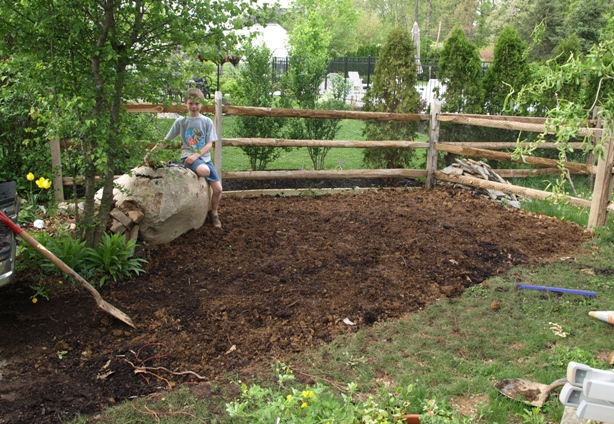
But not too much later - remember, those plants were all waiting in their pots, and wouldn't remain happy much longer. So already the next day, I set to work. Luckily, it had rained a few days before the sale, and the soil was still suitably damp. With the help of my father, who was visiting from the Netherlands, it didn't take long to strip the sod off the plot, perhaps ten by fifteen feet in size. The next phase was harder work: digging the soil deep enough to bury the accumulated sod, and mix plenty of organic matter into the heavy clay soil. I got a small part of the way done that Sunday, and tended to other gardening duties during the few days of warm dry weather that followed. Bad move! It doesn't take long for the Pennsylvania dirt (red clay liberally laced with rocks of all sizes) to take on its pre-brick consistency, especially when it's been stripped of its moisture-retentive sod. By the end of the week, digging was nearly impossible. You can imagine my glee when Friday brought drenching rain, a few inches worth, and rehydrated my project. Knowing I had a limited window of opportunity, I wasted no time the following weekend, and completed the project by late Saturday afternoon. By that time, I had buried all the original sod, and additionally mixed a small pickup load of compost (generously supplied by our township) into the soil. The only component that got removed from the mix was rocks (a sizeable pile accumulated during the project). As a result, the bed is a bulge right now, its additional volume raising it above the level of the adjacent lawn. It will inevitably settle, but hopefully never return to its nearly unworkable initial condition.
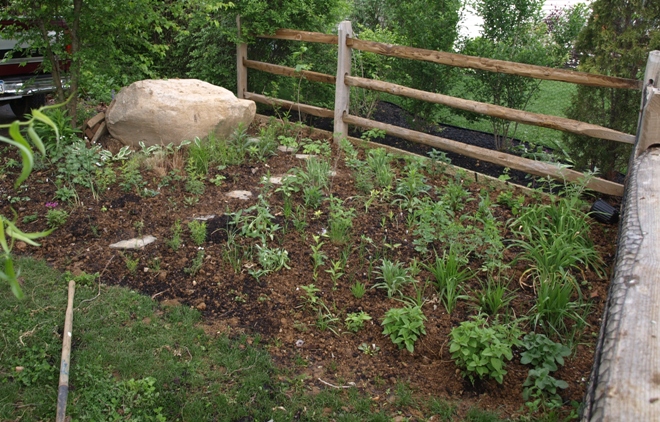
In go the plantsThe next step was more fun (my kids thought so, too): giving all those potted plants a home in the newly dug plot. I'm not much of a garden designer, but at least I tried to make sure that plants with different light requirements and size gradations were properly arranged across the plot - only time will tell if it results in an aethetically pleasing entity. The plot is planted more densely than I would a regular garden bed, so I won't be surprised if it turns into a bit of a tangle by late summer. As long as it's a colorful tangle, that's OK by me.
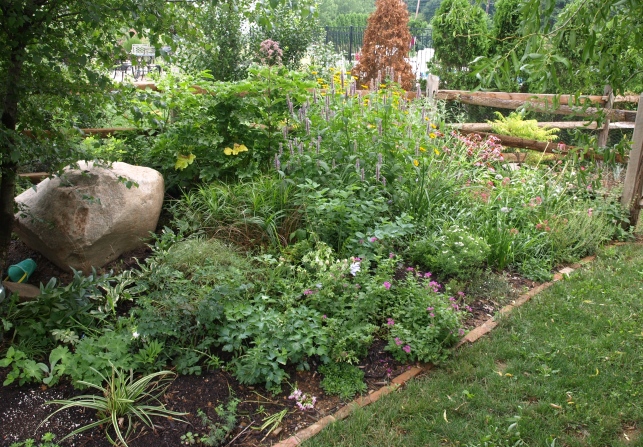
They don't stay cute for long...By late July, many of the plants have grown tall and full. I'm fairly pleased - it's lush, but not too bad of a tangle, and all in all looks pretty good. The next test comes in spring - how will the digging and potting up of all these plants work out? The plants below are growing in our sale plot this year
Last modified:
August 01, 2008 |
|||||||||||||||||||||||||||||||||||