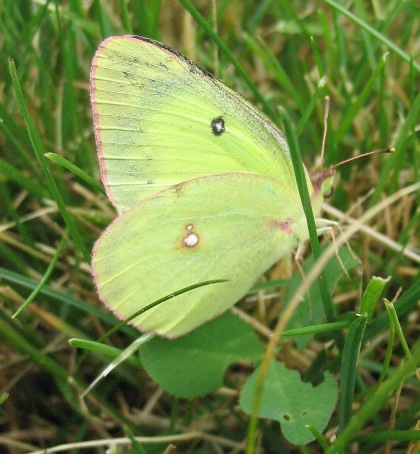
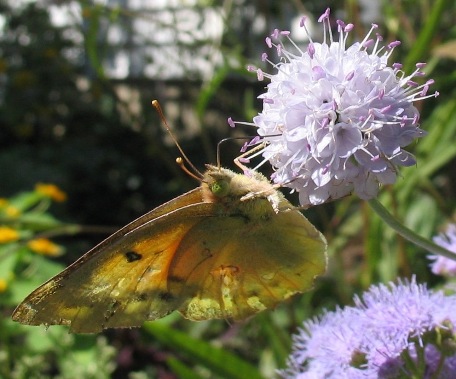
What's a-fluttering?Butterflies are the most popular visitors in most gardens, for sure. Until recently, I would just smile as a butterfly skipped by, and maybe follow it until it disappeared out of sight. But now that I'm armed with a camera, butterflies beware! I've gotten a lot of help from the friendly people at Gardenweb's butterfly garden forum identifying the various species featured here. Another good resource is the USGS Butterflies of North America website, and of course the invaluable help from the folks at Bugguide.net. Most moths are rather non-descript and fly at night - so no photos of those. But there are a few that'll make you take notice quick! Until I started paying attention to my garden's wildlife, I had very little idea what distinguishes butterflies from moths. Friendly webbers pointed me to a nice little page with some basic information. Butterflies and moths go through a full metamorphosis. Some pictures of caterpillars, their larval life stage, are included on my crawlers page. Butterflies
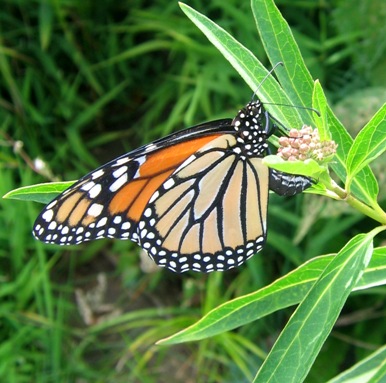
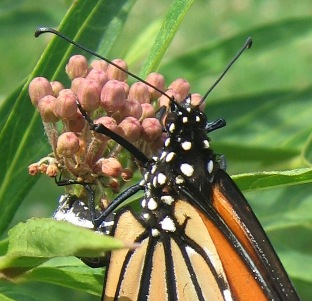
The monarch butterfly, Danaus plexippus, is probably the most famous of the bunch. The photos here document my first sighting of one of these impressive butterflies in our Pennsylvania garden. On one sunny day in late July, there it was, gracefully dancing around the pond and the swamp milkweeds that surrounded it.
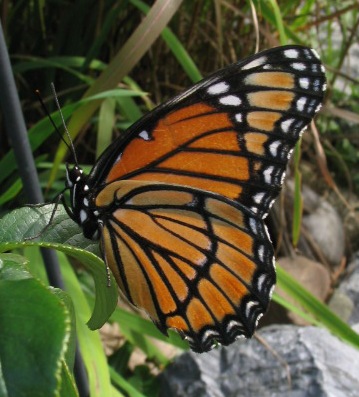
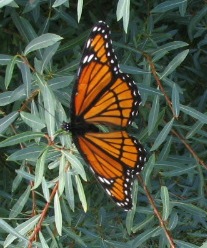
Viceroys are monarch lookalikes. Scientists still argue over the
evolutionary purpose of the resemblance of the butterflies, which are not
closely related species. We just like both of them, each on its own terms. It
so happens that we spotted the viceroy one year before the monarch shown above,
one day in mid-September. We were charmed by a visit by this graceful butterfly,
which spent about fifteen minutes visiting our patio and pond area, and
was not the least bit shy. I loved its gliding, almost floating motion.
Viceroys use willows as caterpillar hosts. Although our arctic willow (pictured
at left) was
among the plants visited, I didn't notice any egg-laying going on - heck,
I don't even know if this was a female...
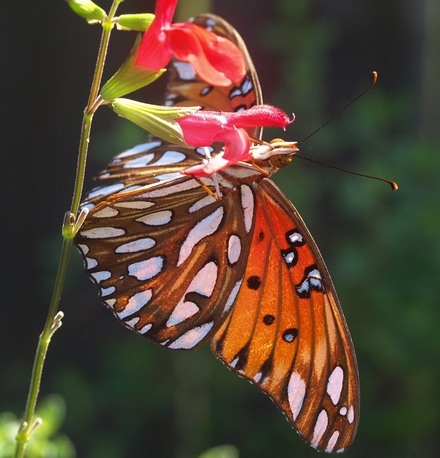
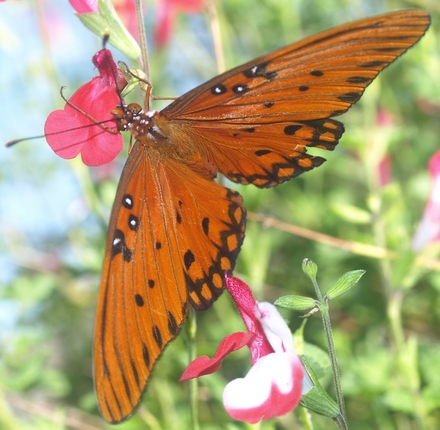
Having moved to Houston, it's only natural that I'd start seeing gulf
fritillaries (Agraulis vanillae) in the garden. For some time, I
would see their cheerful orange shapes flitting about the garden, but they
would never sit still. Finally, one was enticed by our Salvia 'Hot Lips'
for long enough that I managed to snap a few pictures. I was surprised to
see the striking color patterns of the bottom side of its hindwings, which
isn't really apparent when the butterly is in flight. Gulf fritillaries are
common in the southern reaches of the US. The one pictured here, seen in
early October, was likely in the middle of its southward migration to
Florida, where it will overwinter in a frost-free climate. Larval host
plants are passionflowers, which our garden doesn't offer (yet). Still, in
late summer and early fall, these are the butterflies we see most in our new
garden.
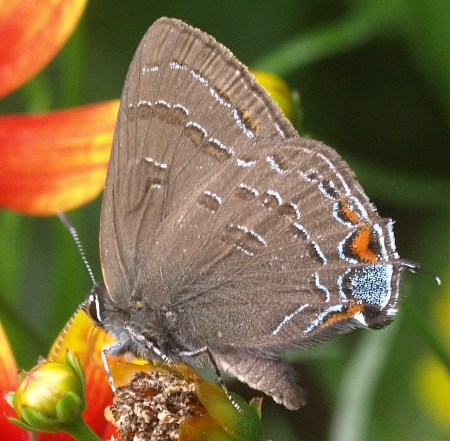
Banded hairstreak (Satyrium calanus), skipping from flower
to flower on a coreopsis in late June. Not a butterfly I see much, perhaps
because it's quite inconspicuous most of the time. There's one generation per
year, flying from June through August. Its host trees include oak, hickory,
and walnut.
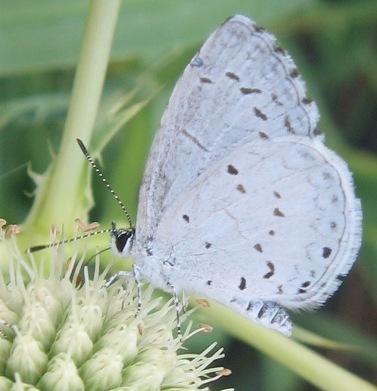
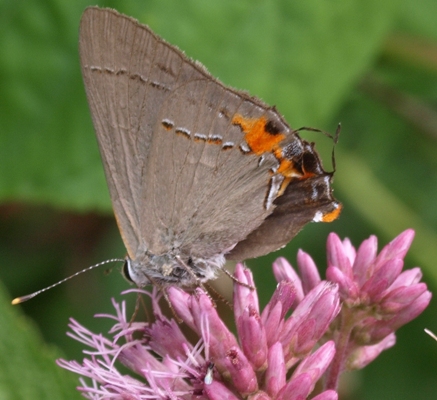
And here's its relative, the gray hairstreak (Strymon
melinus), feasting on Joe Pye weed. I've only seen this species once.
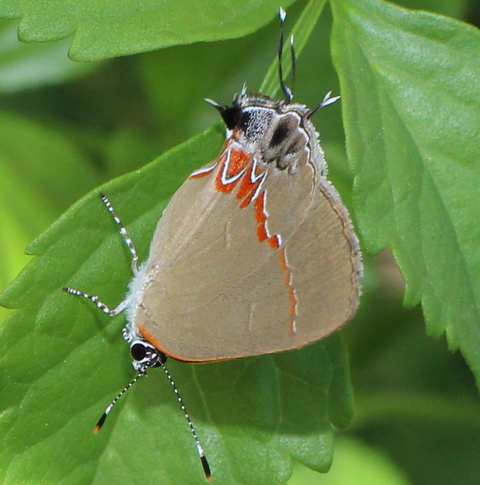
Another hairstreak, although this Calycopis isobeon
goes by the name of dusky-blue groundstreak (although it may be a red-banded
hairstreak – a very similar species). When I noticed this one resting
on our cape honeysuckle, I was unsure what the quivering appendages in the
back end were: was I looking at a mating pair? As it turns out, I was just
fooled by its fake head, whose purpose is more to confuse predators than
humans.
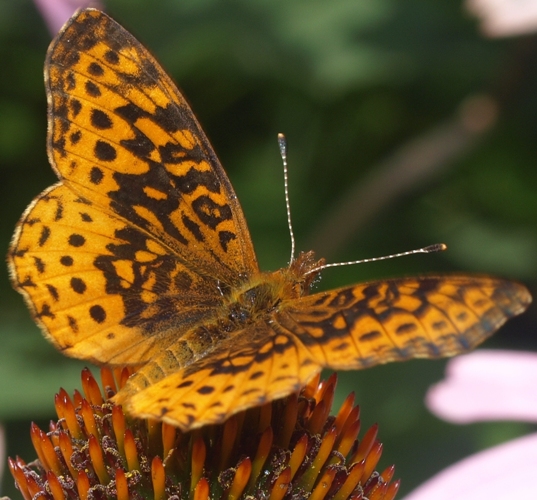
Just when I thought I'd encountered all butterflies that
were likely to visit our garden, this meadow fritillary (Boloria bellona)
comes along to feast on our echinaceas. Its larval host plant is viola, which
our garden has in abundance (V. sororia, to be precise), so perhaps its offspring
is already waiting in the wings, ready to fly out reinforcements in a few weeks.
I wouldn't mind that at all – I was quite pleased with this one's brief
visit.
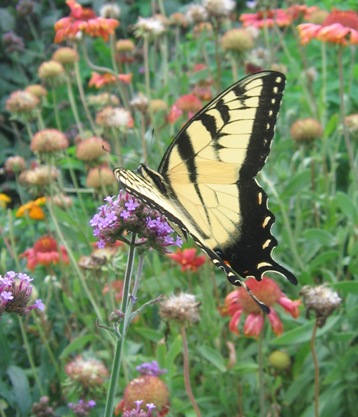
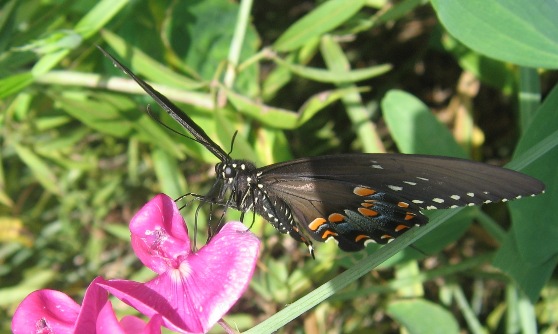
A beautiful spicebush swallowtail (Papilio troilus)
came to visit our garden one day, and just couldn't help but keep coming back
to our perennial pea. I didn't mind having ample opportunity to observe and
photograph its pretty colors and figure.
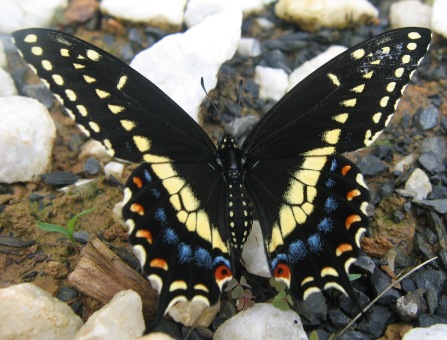
This black swallowtail gal (Papilio polyxenes) had most likely
just emerged, and wasn't too comfortable flying yet. After I took lots of
pictures, bug-boy Ben managed to have her climb onto his hand and carried Ms
Beautiful around for a bit. The first butterfly photos of the year (2006)!
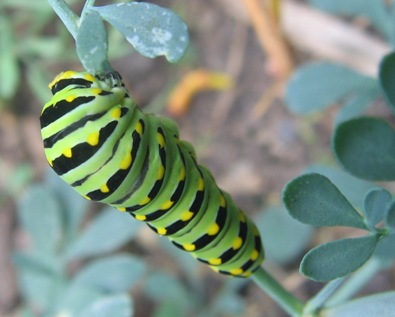
I've also had the pleasure of meeting its offspring in its various
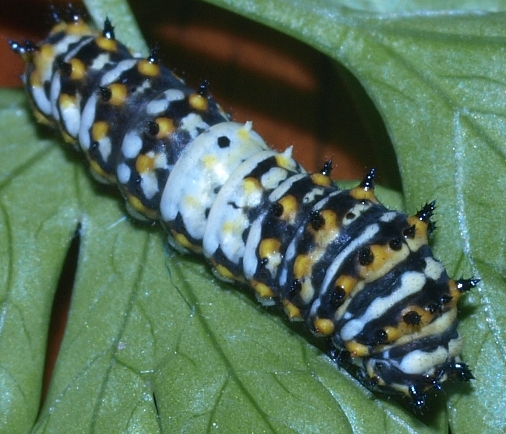
stages. One of them is this colorful caterpillar,
chomping away on our rue.
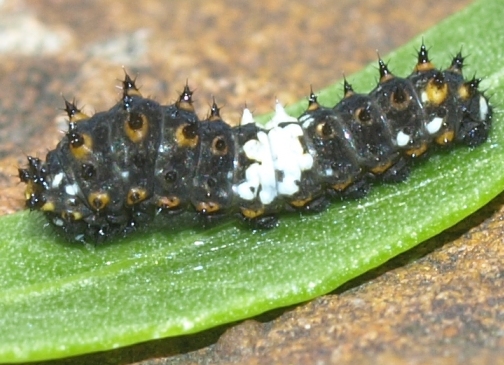
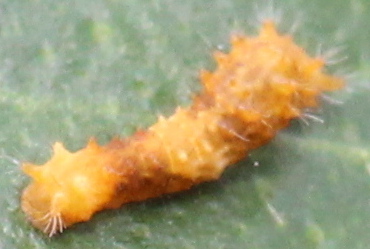
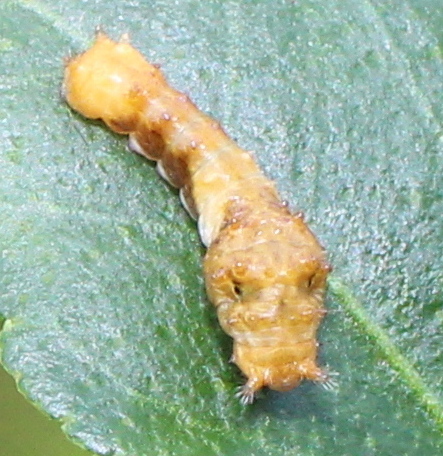
Above and to the right are two earlier larval stages of the same black
swallowtail species. The one at top was perhaps an inch long, the one at right
was real little at well under half an inch long. Isn't
it amazing how many different appearances they take on during their life span?
I found these on a parsley and a lovage plant in early to mid-June.
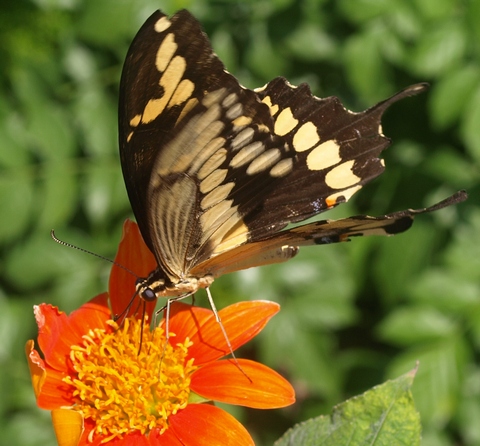
More than ten years later, we're establishing a new garden in Texas, and
wouldn't you know it – there are swallowtails here too! Although I've
seen several species by now, this boy was the first large butterfly I managed to capture on
digifilm (and not very well, either: he had to flutter hard to keep his
balance in the stiff breeze that was blowing in our back yard). It's visits
like this that remind me why I put so much sweat into building a colorful
garden! Although at first I thought this was a boy black swallowtail, it turns
out that this one was actually a giant swallowtail (Papilio cresphontes),
whose caterpillars feast on the citrus (and other members of rutaceae) that
are so prevalent around here.
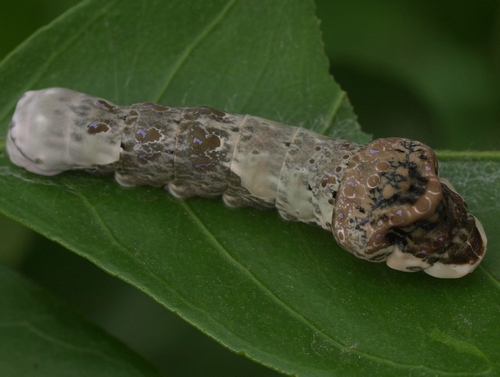
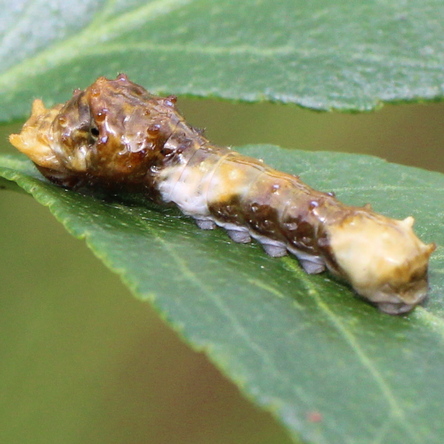
What's that silly little snakelet doing on my satsuma orange tree?
Turns out it's a caterpillar of that giant swallowtail (Papilio cresphontes)
engaged in its elaborate mimicry. He never had me convinced he was a real
snake, but perhaps it works on some of his potential predators. In any case,
I'm happy to give up a few leaves of our satsuma for the benefit of a magnificent
butterfly (citrus relatives are indeed its larval host).
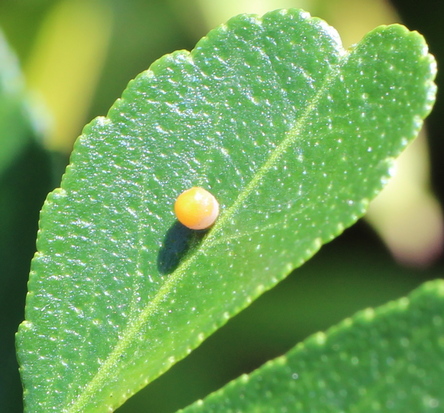
A few years later, another sighting of an adult giant swallowtail visiting
a trifoliate orange led to a close inspection of her landing zone, and sure
enough: there were eggs deposited on several leaves. A few days later, I went
back to inspect and found the early-stage larvae shown below, with one in its
illustrious bird-poop phase. Good thing the adults turn out looking nicer.
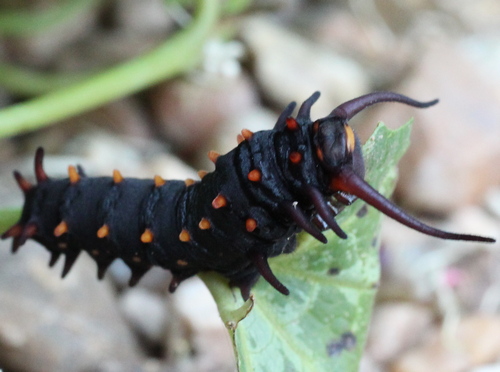
Success! I planted a few low-growing varieties of
pipevine (Aristolochia) in hopes of attracting pipevine swallowtails,
and was glad to spot its caterpillar on one of my Aristolochia
fimbriata plants one late-September day. An ominous-looking one, don't
you think? I didn't witness mama that time, but I was hopeful to see some
adults sooner or later.
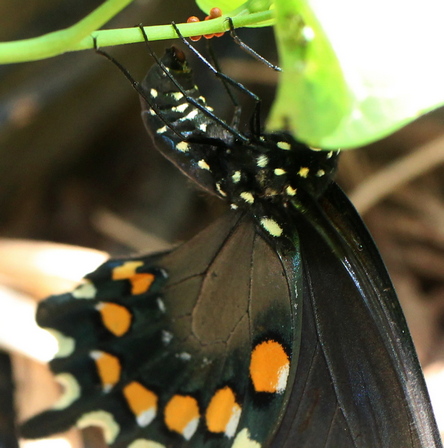
The following year, on a hot afternoon in early May, I was
lucky enough to see just such a lovely lady swallowtail. I didn't recognize her
by her appearance, but from her attraction to the white-veined pipevines it was
obvious who she was – and up-close inspection showed that she was busy laying
her eggs along the stems of those pipevines. I expect them to be viciously
attacked in the near future. And that's OK – it's most of the reason why I
grow them!
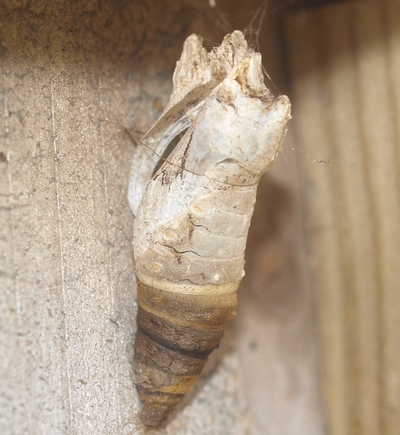
I spotted this empty shell of a chrysalis one late-October day, perched high
on our back-yard fence. I have no idea how long it had been there, or when it
was vacated, but it was certainly an impressive structure. I was told it had
belonged to a swallowtail butterfly; given my observations around the
Houston garden, that makes it likely a black swallowtail. Next time around, I
hope to spot the pupa before the butterfly emerges!
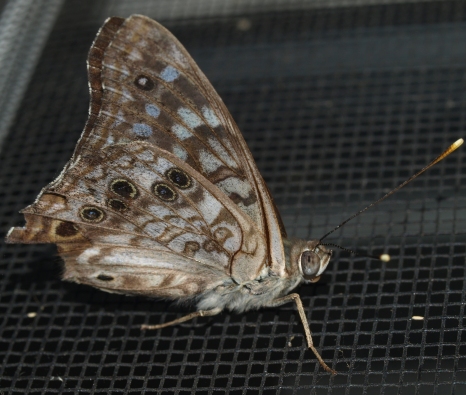
I've seen this one only once, on the patio screen door right outside of our kitchen, one summer evening as dusk was approaching. It's a hackberry emperor (Asterocampa celtis), a butterfly known for its flighty behavior, not sitting still for pictures very often. I don't know where its host tree is, because I'm not aware of any hackberries in the neighborhood.
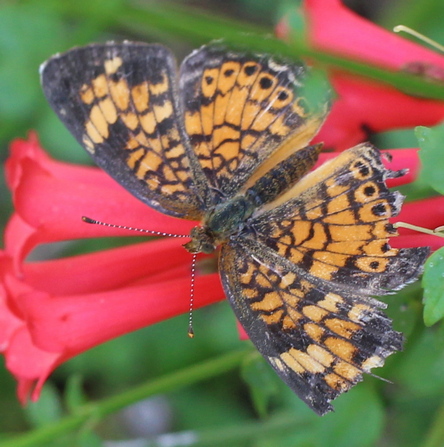
My first "new" butterfly in 2022, this pearl crescent (Phyciodes tharos) is
looking decidedly battered, but was still fluttering around the garden borders with
great vigor, here seen scouting out some firecracker plant flowers. Its kin is
common through most of North America, but I hadn't spotted it in 25 years of
gardening in the US. Caterpillars feed on plants in the aster family (of which
there are many in the garden – ornamentals as well as weeds.
The question mark butterfly (Polygonia interrogationis) is not one I've seen often in our
garden – and the one time I spotted one with camera at hand, I didn't get very good pictures,
but I managed to get at least glimpses of both the upper and undersides of its wings, which are
amazingly different, and the latter does show the white pattern of curved line and dot giving rise
to its common name. It likes to live near wooded areas, so it's perhaps not surprising that this
suburban wasteland is not so much to its liking (notwithstanding my efforts to make our backyard
appear somewhat wooded). QM's caterpillars feed on a wider variety of plants than many other butterfly
larvae, including elms, hackberries, and nettles (none of which are present in our garden).
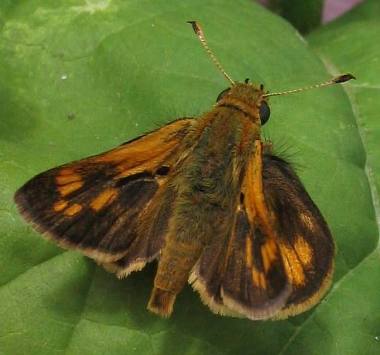
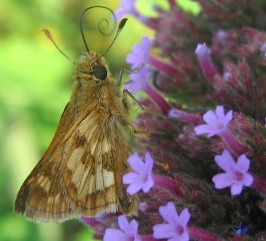
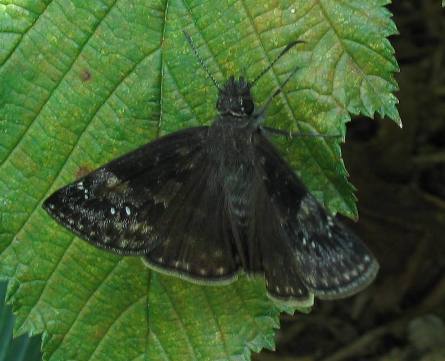
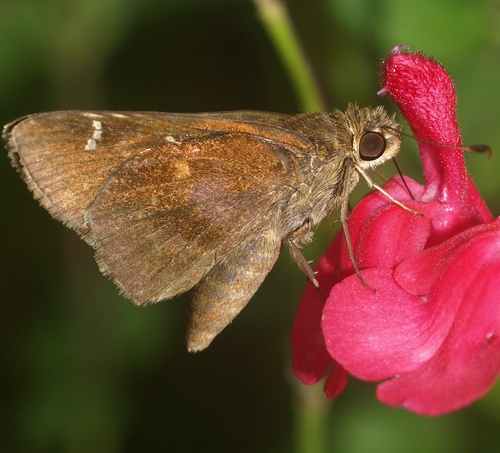
SkippersSkippers (family Hesperiidae) are considered butterflies, but they are somewhat separate from their Papilionoidea brethren. In general, they are smaller and more skittish in flight, and most of the ones I've seen (with some exceptions as shown below) have more muted colors than those flashy big butterflies. So I keep my collections of skippers a bit separate, below.
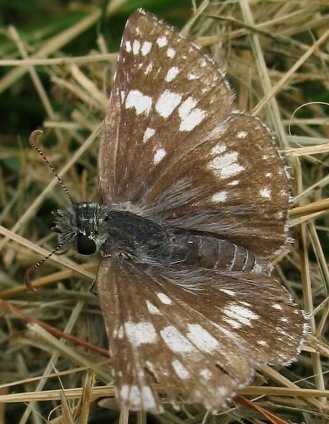
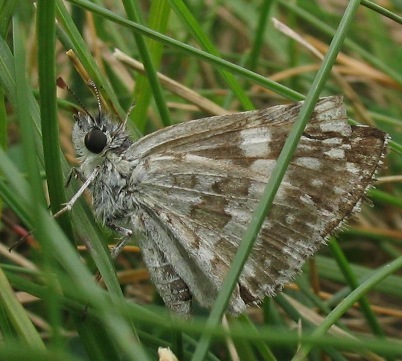
The checkered skipper (the one pictured here is probably Pyrgus communis)
is a smaller butterfly - not much more than an inch in wingspan. Most of the
ones I encounter are very flighty, sunning themselves for a few seconds at a
time at perches near ground level, and never stopping for a photo op. But this
one, found on a cool October morning, was much more docile, allowing me to
shoot close-up photos and even sitting on my finger for a few seconds.
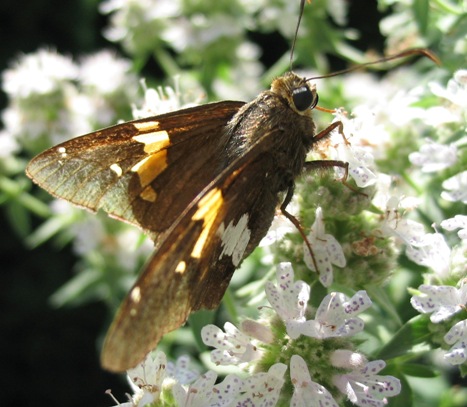
Silver-spotted skippers (Epargyreus clarus) were among the most
common butterflies we'd see in our Pennsylvania garden. They normally
prefer their flowers in the blue and red spectra, but the one pictured here
just couldn't resist our mountain mint.
All of a sudden, in late July, Peck's skippers (Polites peckius)
would descend upon our Allentown garden. They'd be all over! Although
diminutive, they are fast fliers.
This skipper is most likely a wild indigo duskywing (Erynnis baptisiae),
although baptisia was not among the many plants it visited when I found it
fluttering through the garden.
My first skipper sighting since moving to Texas, this clouded skipper
(Lerema accius) is a little brown job among its more colorful brethren,
but I was happy to spot it nonetheless. Its range, mostly the southeastern U.S.
and further south into the Americas, doesn't quite include our previous garden
in Pennsylvania, but it is quite similar in many respects to the skippers we
saw there, documented above. They started appearing in July, and were quite
plentiful by mid-August, continuing well into October. This one was nectaring at a salvia flower.
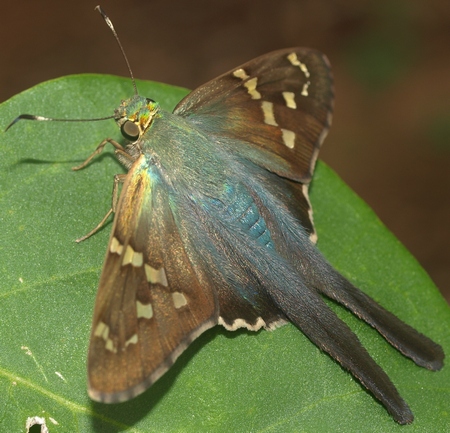
When I first saw this irridescent beauty, I mistook it for a day-flying
moth, but soon learned it was in fact a long-tailed skipper (Urbanus
proteus). It occurs year-round here in Texas (and along the gulf coast and
Florida), while it flies in late summer and fall in other parts of the eastern
United States. Its caterpillars feed on plants in the bean family. I never did
see it in Pennsylvania, but have spotted it quite a few times in our Texas
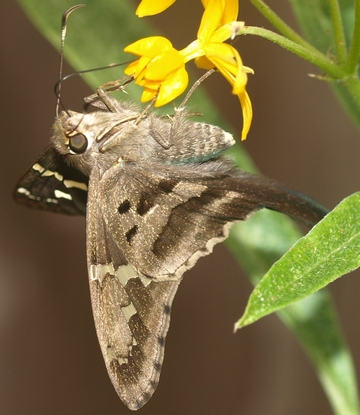
garden. As the photo at right shows, the underwings have a much more muted
coloration, so that I don't always recognize individuals fluttering about as
this species. But whichever side of their wings they show, they're most welcome.
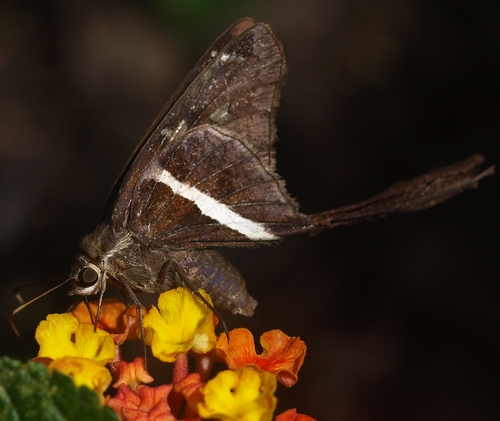
Just a few weeks after the first longtail sighting above,
two other longtails were darting around our lantanas on a warm Saturday
afternoon. While not quite as striking, I'm still happy that these white-striped
longtails (Chioides albofasciatus) chose to vist our garden. They range
from central America to the southwestern U.S. through to Louisiana, flying
from early spring to late fall. As with its cousin above, its larval hosts are
plants in the legume family.
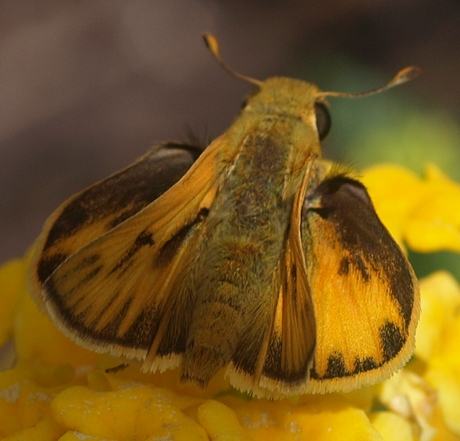
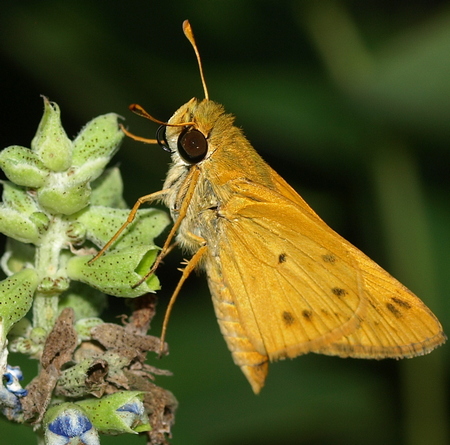
Sometimes it's hard to judge, when you spot a skipper flitting
about, if it's one you've seen before or a new species. I had no such trouble
with this fella: the firy skipper (Hylephila phyleus) is quite
distinctive, with its yellow-orange overtones, bold patterning, and smoothly
rounded hindwings. This member
of the grass skippers uses bermudagrass as one of its host plants, which should
make it quite happy in our neighborhood, with acres of the stuff. Its range
includes a broad swath of the eastern and central U.S., but I had never spotted
it in Pennsylvania.
In mid-summer of the following year, I spotted this individual,
another firy skipper, resting on a spent salvia bloom. The bottom-of-wing
markings are quite a bit different from the top-of-wing ones, so here's
another photo for comparison.
MothsFrom the dramatic to the barely noticeable, here are the moths I've managed to take snapshots of through the years.
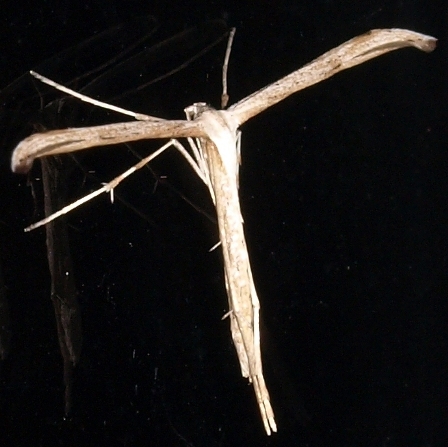
We found this one on the outside of our kitchen patio doors one evening,
looking very much like it was Trying To Tell us something.
It's definitely a plume moth, and most likely the morning glory plume moth,
Emmelina monodactyla. I think that species name means "one-fingered",
but I don't know how to count moth fingers! The larvae of this species feed on
plants in Convolvulaceae, so I may have my bindweed infestation to
thank for this moth's visit.
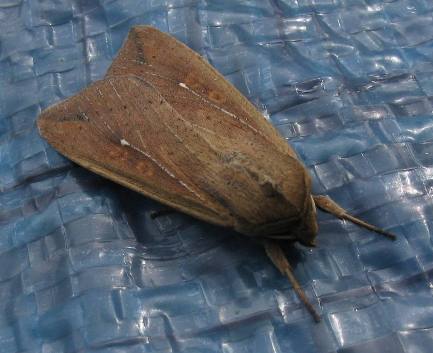
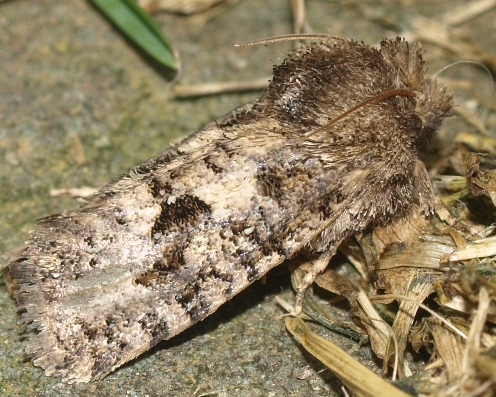
One hot summer afternoon, I went to look at a hypertufa
trough that was just about ready to be planted, when I spotted an excellently
camouflaged moth sleeping on the side of the trough. It was quite content to
let me take a bunch of photos right in that spot, but was annoyed when I
prodded it, fluttering off to a nearby flagstone where it settled down again.
That's where I took this picture, which shows the antennae (they were hidden in all
the scruffiness in the original position).
I found that this is a tubeworm moth (Acrolophus arcanella), which is native to a large swath
of the eastern U.S. Its larvae feed on roots of clover, which is certainly
present in our garden. It probably figured the trough would be a nice quiet place
for a nap...
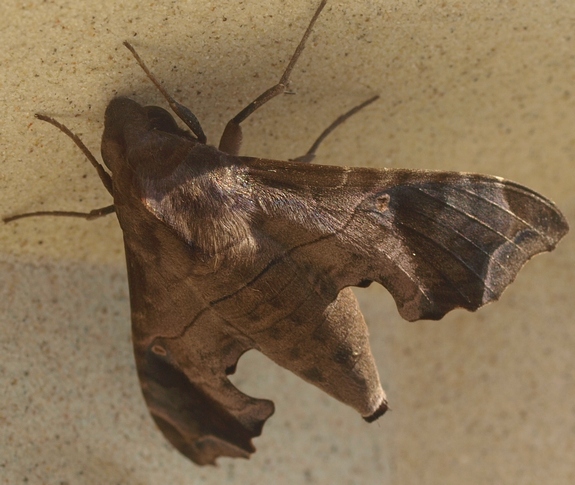
First moth picture from Texas – this big moth was perched right outside our front door, sitting perfectly still in the sunshine. It is a mournful sphinx (Enyo lugubris), which occurs in tropical America and southern North America, occasionally venturing as far north as the midwest and New York. Even though this one sat still for me to take its picture, it does fly during the day. Its larval hosts are plants in the grape family, adults feed on flower nectar. It reportedly makes a whirring sound when flying, but I haven't witnessed that yet.
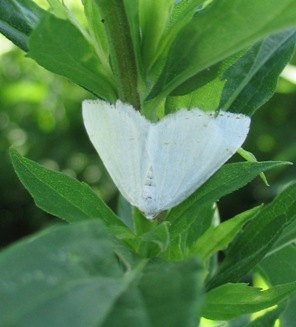
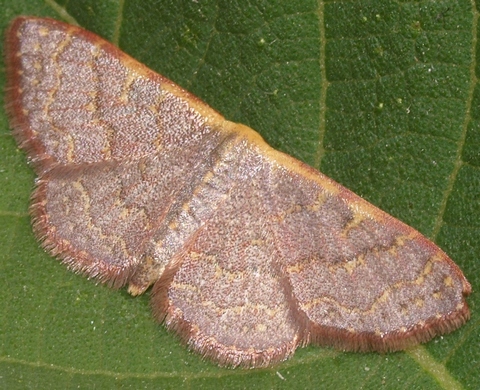
I spotted this little beauty as it was sunning itself one afternoon on a
fig leaf. This is most likely a Pannaria wave moth (Leptostales pannaria),
in the family of geometrid moths. It is found in the southeastern United States
and Caribbean.
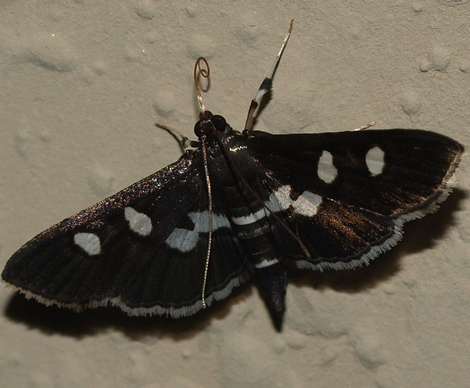
Somehow, this brightly marked moth found itself inside one
evening in September. It belongs to the genus Desmia, and may be a
grape leafroller (D. maculalis or D. funeralis), but there are
other species with similar markings and general appearance.
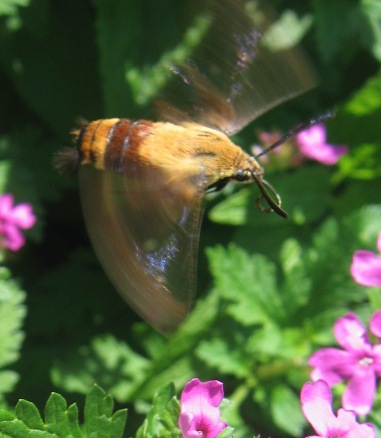
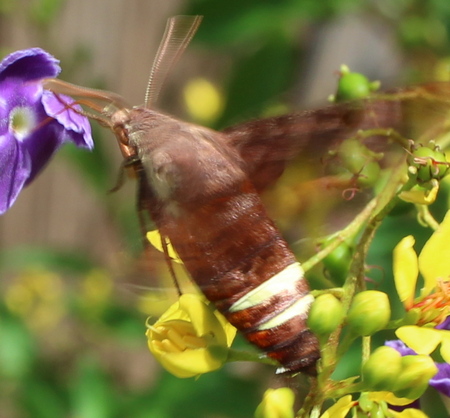
One hot summer afternoon, this day-flying nessus sphinx
(Amphion floridensis) was methodically visiting all the flowers of
our backyard Duranta erecta. That means I had lots of time to
photograph this magnificent large moth, but since it never sat still at all,
I only got blurred-wing photos. Still, I'm happy to have captured it in motion
– even though it occurs through a large part of the eastern US, I had
not previously encountered it.
Lily found several of these striking moths hiding behind
some bins on our patio. They are, not very ingeniously, called white-tipped
blacks (Melanchroia chephise), and are common in Texas and Florida,
with a range extending down into South America. Their larvae feed on plants
in the Phyllanthus genus – which describes two common weeds in our
garden. So these adults may very well be home-grown, even though I never
spotted their caterpillars (also strikingly colored, in a patchwork of
yellow, black, and white).
Visitors to this page have left the following comments
I welcome comments about my web pages; feel free to use the form below to leave feedback about this particular page. For the benefit of other visitors to these pages, I will list any relevant comments you leave, and if appropriate, I will update my page to correct mis-information. Note that I discard any comments including html markups, so please submit your comment as plain text. If you have a comment about the website as a whole, please leave it in my guestbook. If you have a question that needs a personal response, please e-mail me.
Last modified:
January 04, 2026 |
||||||||||||||||||||||||||||||||||||||||||||||||||||||||||||||||||||||||||||||||||||||||||||||||||||||||||||||||||||||||||||||||||||||||||||||||||||||||||||||||||||||||||