 |
Bees and wasps in our garden |
 |
Bzzzzzz....
Already in early spring, bumblebees help bring the garden alive. By
mid-summer, the garden is abuzz with bees, bumblebees, and wasps of all
shapes, colors, and sizes. There are also lots of flies that look like
bees or wasps – you'll find some of them on my flies
page. Since I don't know which sting and which don't, I tend to keep my
distance, but I've captured some of the most interesting ones on digital
film.
Bees
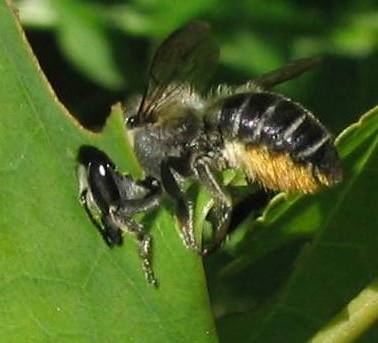
Leaf-cutter bees use pieces of leaves (in this case, from an empress tree)
to build their nests. This is most likely a female Megachile brevis,
a widely distributed species.
Pennsylvania, September 2004
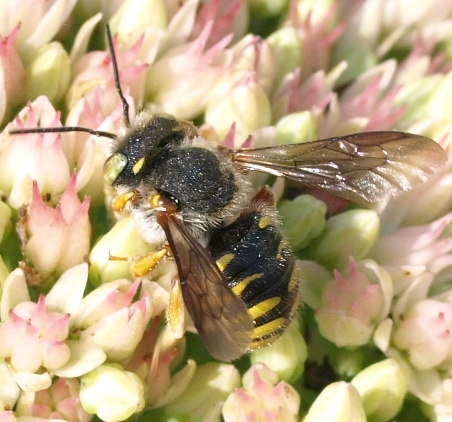
This is another leafcutter bee: Anthidium oblongatum, an introduced
species from Europe. I had a good time watching him (yes, it's a boy) one
afternoon. He was buzzing around a large sedum,
alternating between sitting down on the flowers for nourishment and
attacking other insects that were feeding from the same plant. Many of the
insects were much larger, such as brown and yellowjacket paper wasps. They
acted annoyed, but didn't actually leave, much to the bee's chagrin. Apparently,
this sort of territorial behavior is common for males of this genus.
Pennsylvania, August 2009
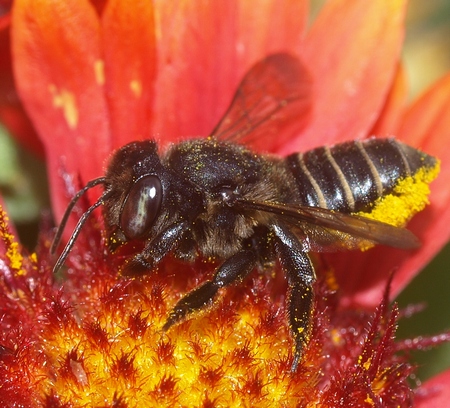
First leafcutter bee I encountered in our Houston garden,
this is Megachile pruina nigropinguis, snacking on gaillardia flowers one balmy July morning. It was certainly
getting a good haul of pollen! The species is found in the southern US from Texas to
North Carolina, while the subspecies has been reported in the western part of
this range.
Texas, July 2017
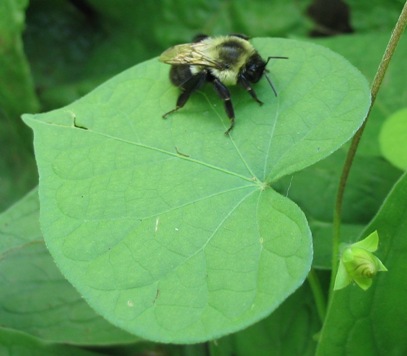
Bumblebees are ubiquitous, and welcome, visitors to our garden. They are there
in early spring for the first flowers, and just keep on going through the season.
One chilly mid-summer morning, we found this cute little guy snoozing on a
morning glory leaf. Sweet dreams...
Pennsylvania, August 2004
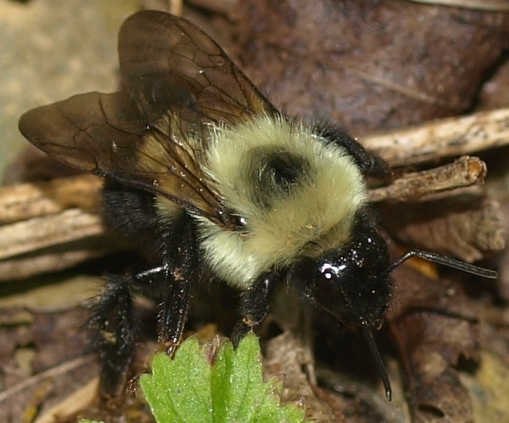
This two-spotted bumblebee (species Bombus
bimaculatus) was one of a colony that I inadvertently disturbed while
cutting back some tattered sedge. They are quite fearsome when they swarm
in defense of their home, and their stings certainly smart, but when they've
forgotten about the transgression, they are right back to being pleasant
garden companions.
Pennsylvania, May 2014
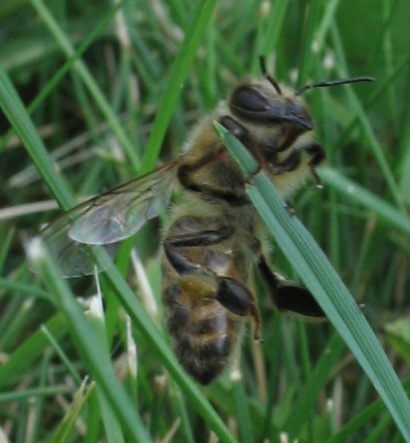
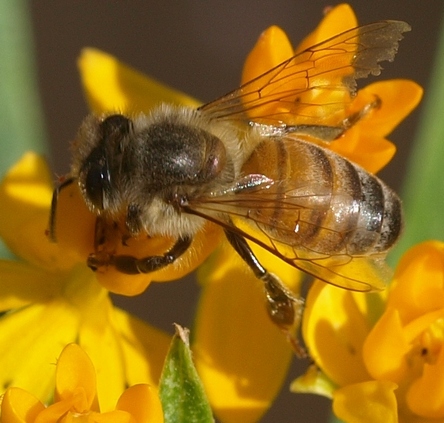
The honeybee (Apis mellifera) at left was taking a well-deserved rest hiding in
the lawn, while the one at right was feasting at a milkweed flower.
Pennsylvania, September 2004 and Texas, November 2017
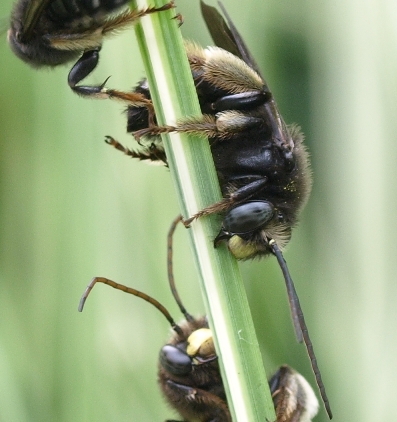
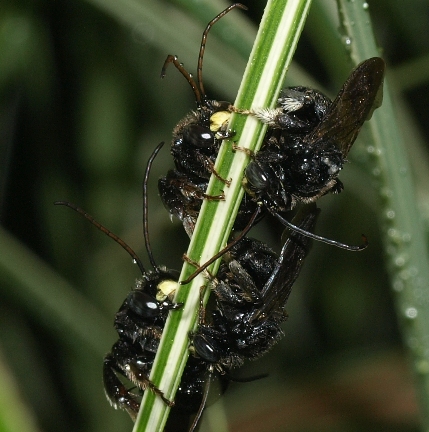
Late one afternoon, on an inspection round near our filtration bog,
I noticed odd behavior by some dark-colored bees: they were crowding onto a
single blade of our maiden grass, and appeared to stay put. I learned from
an inquiry at Bugguide.net that this is common behavior for long-horned bees,
as they congregate to rest for the night. Sure enough, they were still there
the next morning, now neatly arranged in a foursome (two of which were facing
head down!).
These particular individuals are males of Melissodes bimaculata.
Pennsylvania, August 2009
Wasps
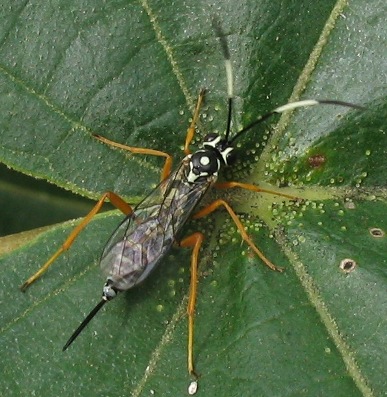
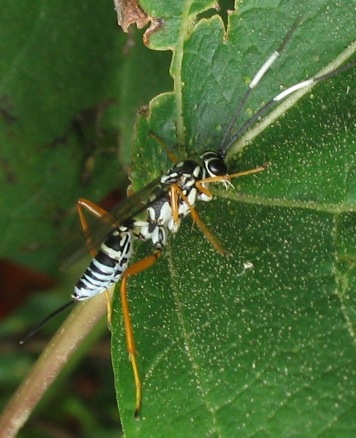
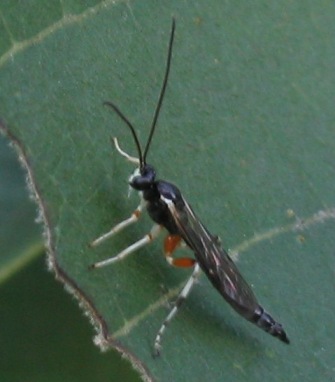
Amazing, the creatures you find when you start looking.
I had never heard of ichneumons until I developed an interest in insects,
let alone spotted one, even though, as the pictures show, they can be quite
colorful. Ichneumons are a very large group of insects, who prey on other
insects to feed their larvae. The two photos above are of the same female
Cryptanura septentrionalis. The one at left, clearly a different
species, is a male.
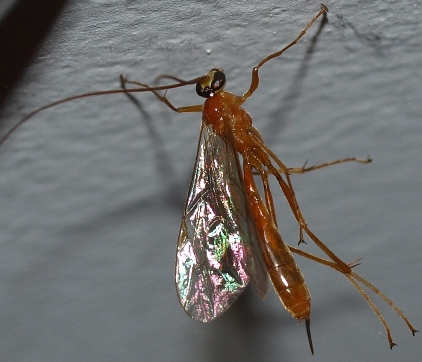
This one was actually indoors - at first glance, you might mistake it for
a mosquito, because it dances around in its light-weight way in a similar
fashion. But the second glance shows it's something quite different: another
ichneumon, a female in the Netelia genus. See the really long antennae?
It's nearly impossible to get them in focus, since they stick out so far from the rest of
the body.
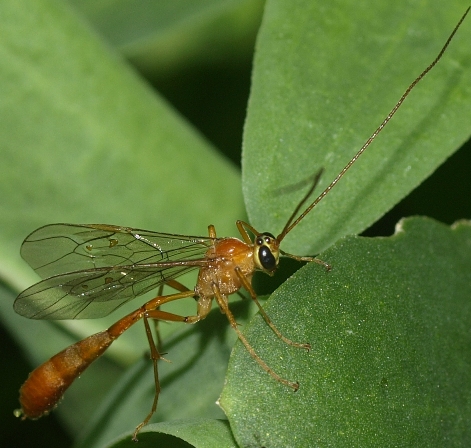
Looking fairly similar to the one above, this male
ichneumon is a representative of Enicospilus purgatus. The smaller
black protrusions between its eyes are a striking feature on this one. I
found it one evening just climbing away amid low-growing foliage, never once
using its wings. I wonder if it had just emerged and wasn't yet able to
fly.
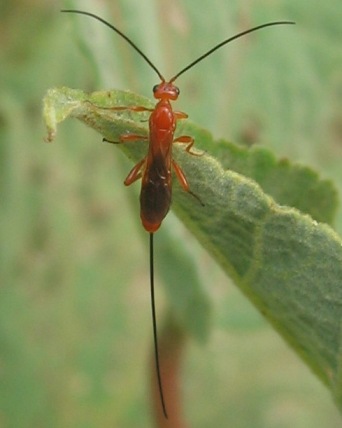
This elegant little thing is a braconid wasp. The long ovipositor
leaves no doubt that it's a female.
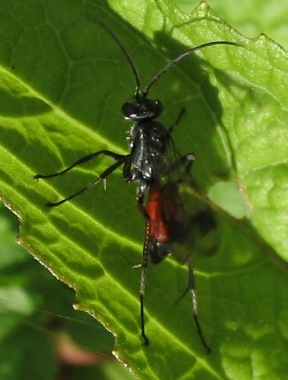
Spider wasps are usually seen rummaging through debris at ground level, in search
of the spiders they paralyze as food for their larvae, but this one (Calicurgus hyalinatus)
was flying around some garden foliage.
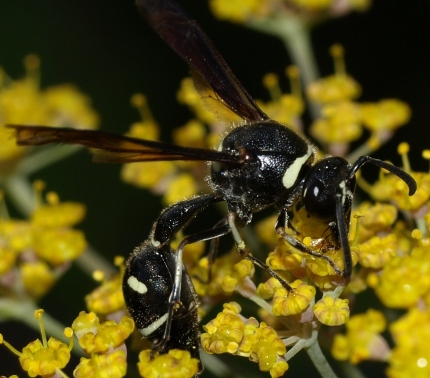
Potters wasps build nests of mud, where their larvae live on
caterpillars brought to them by their doting mothers. This one is most likely
a female Eumenes fraternus, here shown feasting on fennel flowers.
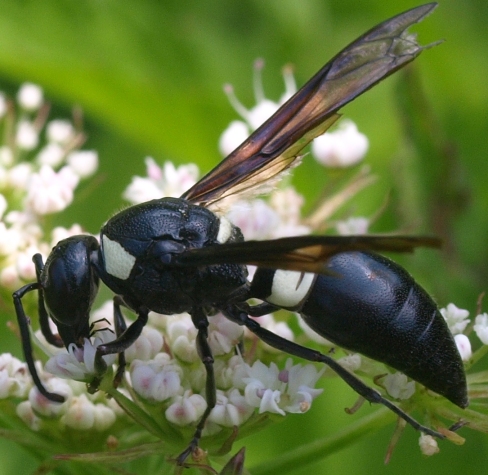
This four-toothed mason wasp (Monobia quadridens)
is common through the eastern United States. It usually nests in wood
borings. I found the one pictured here enjoying the watercress flowers in
our big pond's filtration bog.
|
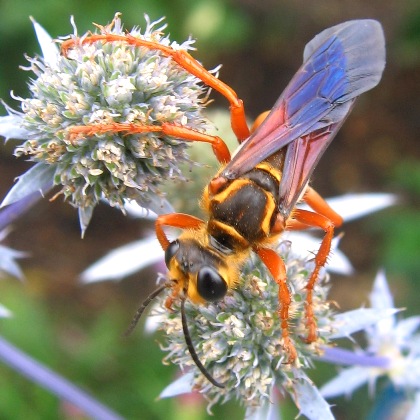
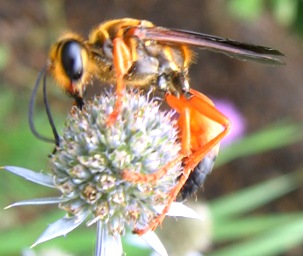
Apparently, the great golden digger wasp (Sphex ichneumoneus) only
flies a few weeks out of the year in these Northern reaches of its territory
- so perhaps I should feel lucky he chose a flower in our garden to sit down
on. I was just happy he didn't sit down on me... Both this year and last year,
we first spotted it around mid-July, and both times it was enjoying our sea
hollies.
|
|
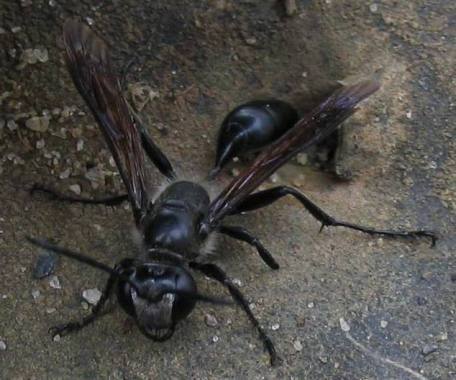
This fella looked like he was a bit injured, and was crawling around near our
pond. I have it from a good source that this is a grass-carrier wasp
(Isodontia apicalis), recognizable by the silver face and the white hairs
on its midsection.
|
|
|
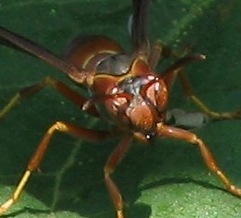
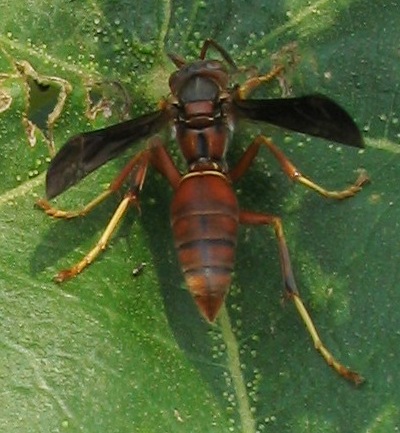
Handsome brown paper wasps (most likely Polistes fuscatus, the
northern paper wasp) help themselves to some honeydew left by aphids on our
paulownia tree. Even though the one above looks really ticked off, they're
not particularly agressive.
|
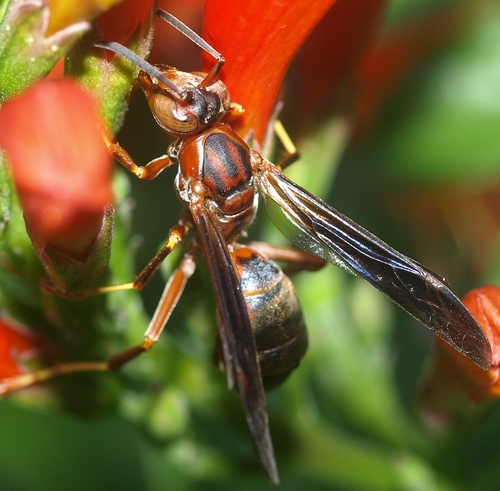
We have paper wasps in Texas, too. This is a different
species from the one above (Polistes metricus), but overall quite
similar. They like to build their nests in the overhang above our patio and
under our eaves, and generally hang out around the garden, although I don't
think they take nectar from flowers. This female is inspecting a Cape
honeysuckle that's still in bloom in mid-November.
Texas, November 2017
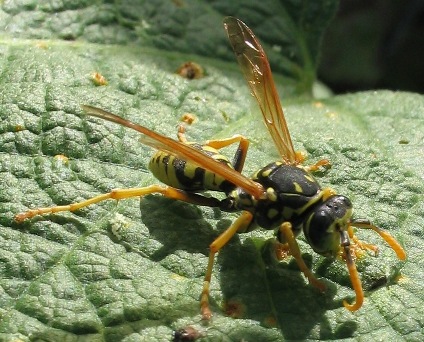
This is a yellowjacket paper wasp (Polistes dominulus), which looks
somewhat similar to the yellowjackets often seen buzzing around trashcans, but
is not closely related. Introduced from Eurasia in the 1980s, it has colonized
most of the U.S. by now. They can be agressive if their nest is threatened,
but are perfectly peaceful buzzing through the garden in search of insect prey.
The one shown here is a male, as evidenced by his yellow face and hooked
antennae.
Pennsylvania, September 2004
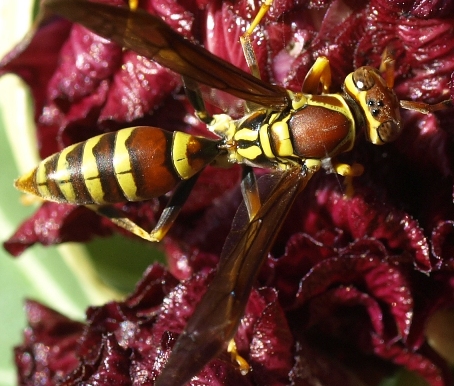
Another paper wasp, this is Polistes exclamans, which
occurs in a large swath of the central and eastern United States. These
social wasps nest under roofs and in trees, and prey on caterpillars. Good
to have around to balance out the local ecosystem.
Pennsylvania, September 2009
Also seen in Texas, June 2017
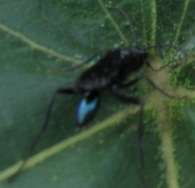
Another black wasp, this one with a shiny metallic-blue rear end. A blue
mud dauber (Chalybion californicum), seemed more agressive than most
wasps I encounter - so I didn't get too close with the camera.
|
|

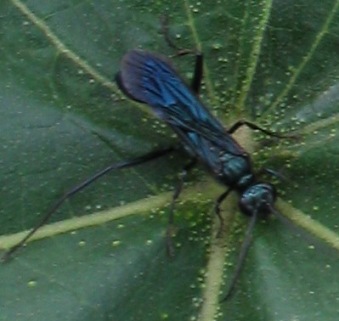
Here we have another mud dauber: the yellow-legged mud
dauber wasp (Sceliphron caementarium), which I believe is responsible
for most of the mud structures we find attached to various surfaces around our
patio. There must be quite a few around, but I don't see them often in the
garden areas, so I wasn't aware that this was an old familiar friend when I
spotted it sitting quite persistently on some low-growing plant one late afternoon
in spring. The species is widespread through North America, and lives a solitary
life. It probably likes our patio for building its nests because of its proximity
to our pond, which provides a ready source of building material.
Texas, May 2024
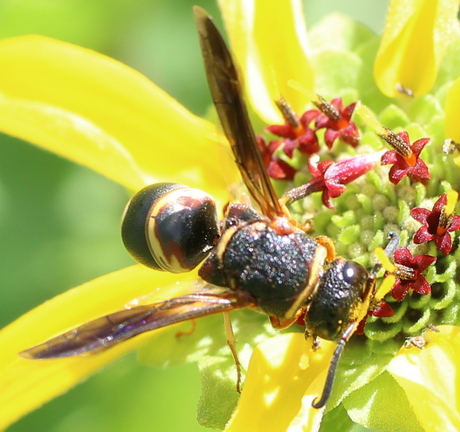
This potter wasp, here seen extracting the sweet
goodness of a Texas green eyes (Berlandiera texana) flower, is a
member of the genus Euodynerus, most likely species Euodynerus
hidalgo. Potter wasps are so named for the urn-shaped solitary nests
they build for their developing larvae, which they supply with paralyzed
prey, such as larvae of other insects and spiders.
Texas, May 2022
Sawflies
Another group of members of the hymenoptera, the order that includes bees and
wasps, are the sawflies. I see more of their larvae (a few of which you can see
on the crawlers page) than adults, but here's a
couple:
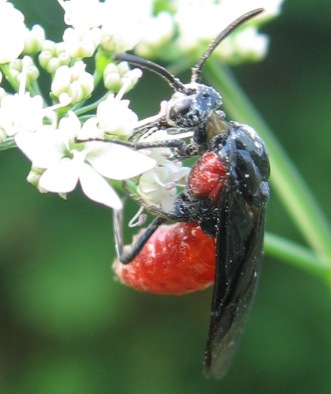
I could see this argid sawfly (argidae family) from a ways away, gorging
himself on coriander flowers. The combination of the shiny black wings and the
red body contrasted strikingly with the white flowers.
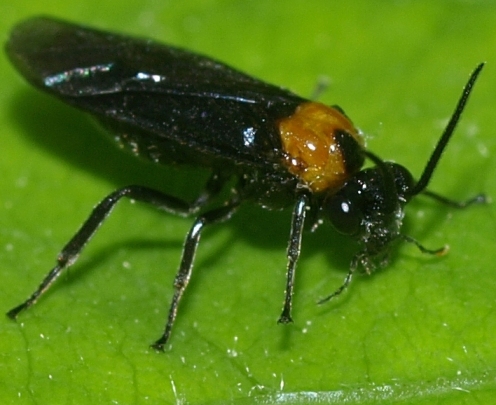
On a warm early-June afternoon, on a stroll past our big
pond's filtration area, I spotted this little sawfly on a Hibiscus
moscheutos plant. As I took aim with my camera, I saw several more, so
they were definitely in their happy spot. Sure enough, this is a hibiscus
sawfly (Atomacera decepta). Which means I may return to the plant one
of these days to find its leaves decimated by sawfly larvae (I have a photo
of the larval stage of this species at my crawlers
page).
Visitors to this page have left the following comments| J_Red | Sep 24, 2005 | which ones are small and brown?
Lots of 'm. Take a look at the guide at bugguide.net for starters. |
| Holly Tashian | Jun 26, 2006 | We seem to have a problem with some sort of bee or wasp that is nesting under our back porch. They have strung 4 of us, in the same place on the back of the leg near the ankle, for no apparent reason. They are fast and black. I can't seem to figure out what these aggresive critters are, or how to get rid of them. Any help would be very welcome.
Holly
|
| Linda | Dec 17, 2006 | Until the Eryngium planum bloomed, I had never before seen a golden digger wasp, and, once again, here, I find it on one of your web pages.....I just love looking to see what other people have in thier gardens. I have a lot of the paper wasps and don't mind them cause they help keep the aphid population in check. |
| Taylor | Aug 09, 2007 | I love the way u took these photos I'm 11 and I think this is Fasanating! ( I spelled it wrong i know)
|
| Amanda v.V. | May 08, 2008 | Amazing photos. With my camera it's all blurry when I take a close-up shot. What sort of camera do you use? (You don't have to answer that question. I would answer Holly's problem first!)
All of the insect photos were taken with my Canon A70 and A95 cameras. Point-and-shoot, but good macro ability. I've not yet tried to work close-up with my new digital SLR yet... |
| Tim McMahon | Jul 19, 2008 | Cool page |
| Greg Dowding | Apr 10, 2009 | Your comments and photos coupled with whispering piano on i-tunes makes tonight Christmas like. Thanks |
| Anne Dickinson | Jul 06, 2011 | Thanks for the identification of the Blue Mud Dauber. They vist the stream to my fish pond and they are so much fun to watch - so animated and dancing all the time. I got up real close to take a picture yesterday so I'm glad it wasn't agressive to me |
| Maria Scott | Aug 14, 2011 | Love seeing all the wasps, especially the Blue Mud dauber, they are all fascinating! thanks! |
| Jesse Loren | May 28, 2012 | You helped me identify my latest bee visitor. I have leaf cutter bees on my digitalis. One large one is defending a grouping of three plants against all other bees, even the four or so that are identical, but smaller than it. I can't tell whether it is male or female, but it has staked out the digitalis in my front yard. Lo, to any who bug it. jloren4322@gmail.com friendly bee person. |
| tofugirl101 | Sep 03, 2012 | These are some beautiful pictures! Great job at taking these - no blurriness or anything. |
I welcome comments about my web pages; feel free to use the form below to
leave feedback about this particular page. For the benefit of other visitors
to these pages, I will list any relevant comments you leave, and if
appropriate, I will update my page to correct mis-information.
Note that I discard any comments including
html markups, so please submit your comment as plain text. If you have a
comment about the website as a whole, please leave it in my
guestbook. If you
have a question that needs a personal response, please
e-mail me.
Last modified:
January 04, 2026
Contact me
|
|